
This Earth Day 2026, we're doing the maths most oat milk brands don't want you to see.
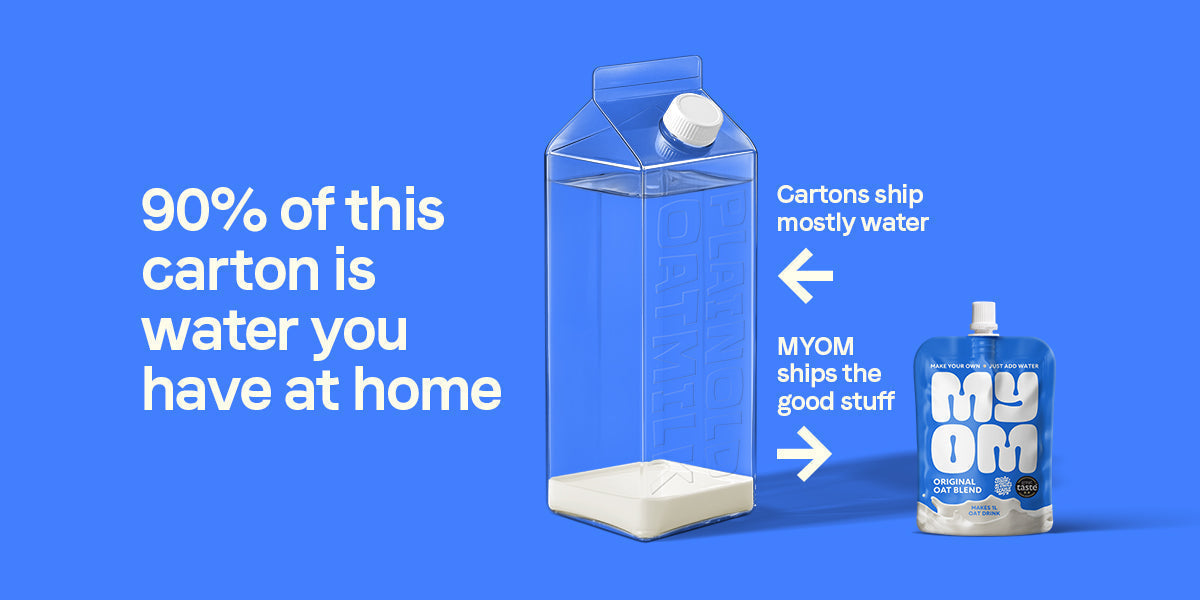
Every week, millions of oat milk cartons travel from factories, through warehouses, into supermarkets and then into your fridge, carrying a product that is, by weight, roughly 90% water.
Water. The thing you have at home. In your tap. For free.
That isn't a design oversight. It's a structural inefficiency that the entire plant-based milk industry inherited from dairy, and one that nobody talked about until now. Because while swapping dairy for oat milk is genuinely one of the most impactful food choices you can make, the carton oat milk in your fridge still carries a surprisingly heavy environmental footprint, one that has almost nothing to do with oats, and almost everything to do with packaging, logistics, and transport weight.
On Earth Day 2026, we're laying out the full picture: the real environmental and financial cost of oat milk cartons, why the premix format changes the equation completely, and what switching means in practice for your household, and for the planet.
Why the Plant-Based Milk Industry Has a Packaging Problem
Oat milk is, unambiguously, better for the environment than dairy. Research published in Science by Poore and Nemecek found that producing a litre of dairy milk generates approximately 3.2kg of CO₂ equivalent, roughly the same as driving 18 miles. Oat milk, by contrast, produces around 0.45kg CO₂e per litre. That's an 86% reduction just by switching the source ingredient.
But that figure, widely cited across the industry, typically measures the carbon footprint of carton oat milk. And carton oat milk has a packaging problem that rarely makes it into the environmental conversation.
The Carton Issue
Most oat milk cartons, including those from Oatly, Alpro, and own-brand supermarket ranges, use aseptic carton packaging. These cartons are made from at least three bonded materials: paperboard, aluminium foil, and polyethylene plastic, all laminated together to achieve shelf stability. Because multiple materials are fused at a molecular level, they are notoriously difficult to recycle. In the UK, only around 29.5% of cartons are recycled. The other 70.5% goes to landfill or incineration.
That means for every 10 cartons you put in your recycling bin, seven are effectively wasted.
The transport weight issue
A standard one-litre oat milk carton weighs approximately 35g empty. Filled with product that is 90% water, it travels the entire length of the supply chain from factory to pallet to warehouse to supermarket to your home, carrying the weight of water you could have added yourself. Multiply that by the tens of millions of cartons sold in the UK each year, and you have an enormous volume of unnecessary transport weight, generating fuel consumption and emissions for no functional reason.
This is what MYOM was built to fix.
The Premix Difference: What Changes When You Remove the Water
MYOM is a 7× concentrated liquid oat premix. You add water at home and shake. The oat drink you make is fresher, cleaner in flavour, and nutritionally equivalent to any carton on the market but the product that travels to your door is a single 130g pouch that weighs just 6 grams empty.
Compare: 6g versus 35g. That's 87% less packaging weight per litre of oat drink produced.
The environmental savings cascade across the entire supply chain:
Packaging waste
MYOM pouches are made from PP5 mono-material. A single polymer, no aluminium, no laminated layers. Because only one material is involved, the recycling process is straightforward. PP5 is collected by 88% of UK kerbside schemes. There is no aluminium to separate. No bonded layers to unbond. You put the pouch in your recycling and it stands a better chance to actually get recycled.
Transport emissions
Shipping less weight means fewer trucks, less fuel, and no cold-chain dependency before the product is made. MYOM requires no refrigeration until after you've added water. The concentrated format also means significantly better pallet efficiency: more product moves per lorry, per journey. MYOM's own Carbon Impact Forecast, independently assessed by EIC Climate KIC in October 2024, places transport emissions savings at up to 90% versus carton oat milk on an equivalent-litre basis. These figures are indicative and reflect average industry benchmarks; actual savings vary by comparison brand and logistics scenario.
Production energy
Unlike oat milk powder, which requires energy-intensive spray-drying or freeze-drying, MYOM is a concentrate, not a dried product. The oats are extracted, but never dehydrated. This avoids one of the most energy-heavy steps in food manufacturing while still achieving the compact format and 12-month shelf life.
Food waste
Because you make only what you need, there are no half-used cartons going sour in the fridge. No waste from over-purchasing. No packaging for milk you didn't use.
The Financial Case: Sustainable Costs Less
The most persistent myth in sustainability is that doing the right thing costs more. In MYOM's case, the opposite is true.
The cost per litre on subscription starts from £1.24 delivered to your door. Oatly, Alpro, and comparable carton brands typically retail at £1.40 to £2.30 per litre in UK supermarkets. For a household consuming around two litres of oat milk per week, a realistic figure for a small family or couple, the annual saving versus a mid-range carton brand is up to £55 per year, depending on which brand you compare against.
That saving comes not from cutting corners on quality or nutrition, but from cutting water out of the supply chain. When you're no longer paying for the cost of manufacturing, packaging, refrigerating, and transporting a product that is 90% tap water, the economics shift.
MYOM Original Oat premix was also awarded 2 stars at the Great Taste Awards 2024, voted Vegan Milk of the Year in 2025 and won 2 Vegan Choice Awards in April 2026. In blind taste testing with regular oat milk consumers, 72% preferred MYOM to their current brand, and 88% rated the taste as very good or excellent.
What Your Household Saves in a Year
Based on two litres of oat milk per week over 12 months:
|
Metric |
Carton oat milk |
MYOM premix |
Saving |
|---|---|---|---|
|
Packaging produced |
~35kg equivalent |
~0.3kg |
~87% less |
|
Cartons entering waste stream |
~104 cartons |
0 cartons |
104 fewer cartons |
|
Refrigeration needed before opening |
Yes |
No |
Energy saved |
Figures are household estimates based on 2L/week consumption. Packaging savings are indicative.
Earth Day 2026: Our Power, Our Planet
This year's Earth Day theme is Our Power, Our Planet and a reminder that environmental progress doesn't require a single law, a corporate pledge, or a political shift. It's built from the daily decisions of families and households.
EARTHDAY.ORG puts it plainly: environmental progress is sustained by communities, educators, workers, and families protecting where they live and work. It's built through everyday action.
Switching from carton oat drinks to MYOM is one of the smallest swaps you can make. You still have it with your coffee, your cereal, your cooking. Nothing changes about your routine. What changes is that 70 cartons per person per year on aveage in UK that then don't enter the waste stream on your behalf this year. A significant volume of unnecessary transport weight doesn't get trucked around the country. A product that is almost entirely recyclable replaces one that mostly isn't.
This is what people-powered change looks like in 2026. Not grand gestures. Just smarter systems adopted one household at a time.
Make Earth Day Everyday from £1.11 per litre delivered
✅ 10% off every subscription delivery
✅ An extra 10% off your first order
✅ Free delivery on cases and orders over £20
How it works
1. Select the product you wish to receive on the regular.
2. Choose Subscribe & Save
3. Use code EARTHDAY26 at checkout
- Applies to your first subscription order only.
- Future deliveries revert to standard pricing
- Cancel anytime
- Valid until 31 May 26 only on 130g cases and multipacks
Frequently Asked Questions
Is MYOM Original Oat free-from milk sustainable, or is it just marketing?
MYOM's sustainability claims are grounded in independently assessed carbon impact data and the straightforward physics of supply chains: shipping less weight uses less fuel. The packaging shift from multi-layer aseptic cartons to PP5 mono-material pouches is a genuine, verifiable improvement in recyclability. MYOM keeps supply chains short and emissions lower. It was recognised by Springwise, the global sustainability innovation platform, as a breakthrough in low-waste milk systems in December 2024.
Does MYOM taste as good as carton oat drinks?
MYOM was awarded 2 stars at the Great Taste Awards 2024, judged blind on taste by the Guild of Fine Food. It contains no stabilisers, no dipotassium phosphate, no gums, and no added sugar. Because it's made fresh when you add water, the oat flavour is notably cleaner than many carton alternatives. In consumer testing, 62% of regular oat milk drinkers preferred MYOM to their current brand.
How does the nutrition compare to carton oat milk?
MYOM Original Oat contains 34kcal, 1.1g fat, and 1.9g naturally occurring sugar per 100ml — lower in fat, calories, and sugar than most leading carton brands. It is fortified with calcium, vitamin D3, vitamin B12, and iodine, matching and in some cases exceeding the micronutrient profile of dairy milk. Both Original and Barista variants are suitable for vegans, lactose-free, soya-free, and nut-free.
What is Tetra Pak packaging actually made of, and why is recycling so low?
Tetra Pak cartons are made from three materials bonded together: paperboard (approximately 75%), polyethylene plastic, and a thin layer of aluminium foil. The aluminium provides the oxygen barrier needed for shelf stability but makes the carton extremely difficult to separate and recycle at standard facilities. In the UK, only around 29.5% of these cartons are recycled — the remainder goes to landfill or energy-from-waste incineration. MYOM's PP5 pouches contain no aluminium and are accepted in 88% of UK kerbside recycling collections.
Is MYOM more expensive than regular oat milk?
No. On subscription, MYOM starts from £1.24 per litre of made-up oat milk. Oatly and Alpro cartons typically retail at £1.40–£2.30 per litre. MYOM is competitively priced against mid-range supermarket own-brand cartons and cheaper than most premium brands — while producing 87% less packaging waste per litre.
Where is MYOM made?
80% of UK sold plant-based milk is imported. MYOM is produced at a BRC-accredited facility in Scotland. This keeps the supply chain short and reduces food miles.
The Bottom Line
The oat milk revolution was supposed to fix dairy's environmental problem. It did, but not as much as it might do. Carton oat drinks are still shipping water you could have added yourself, in packaging that mostly ends up in landfill, on lorries making journeys that don't need to happen.
MYOM loses the water. It removes the carton. It removes the cold chain. And it delivers a better tasting oat drink with full nutrition and a recyclable pouch that weighs less than a 2p coin.
If Earth Day is about anything, it's about using our power to make smarter systems normal. That starts with what's in your fridge.
Keep reading:
- The Carbon Cost of Our Food Systems
- How to Choose The Most Sustainable Oat Drink in the UK
- EU Food Trends 2026: Why Better Oat Milk Starts Without Water
- How to Choose the Best Oat Drink UK 2026
Data Sources & Attributions
- Poore & Nemecek (2018), Reducing food's environmental impacts through producers and consumers. Science, 360(6392), 987–992.
- MYOM Carbon Impact Forecast, Impact-Forecast.com (October 2024).
- Tetra Pak recycling data, WRAP UK.
- EARTHDAY.ORG Earth Day 2026 theme announcement (January 2026).
- Springwise, 'New Low-Waste Oat Milk Products' (December 2024).
- Great Taste Awards 2024 — Guild of Fine Food.