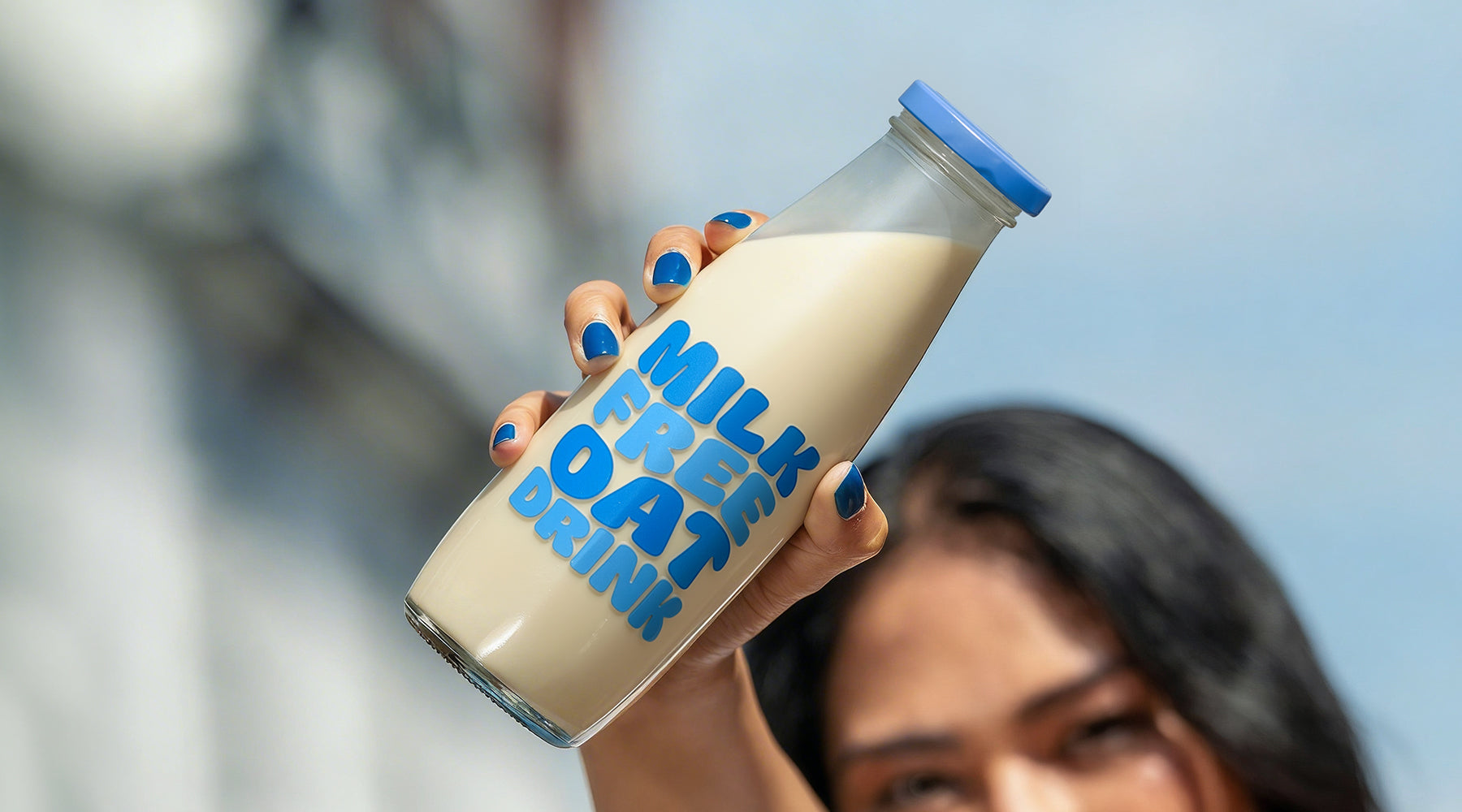

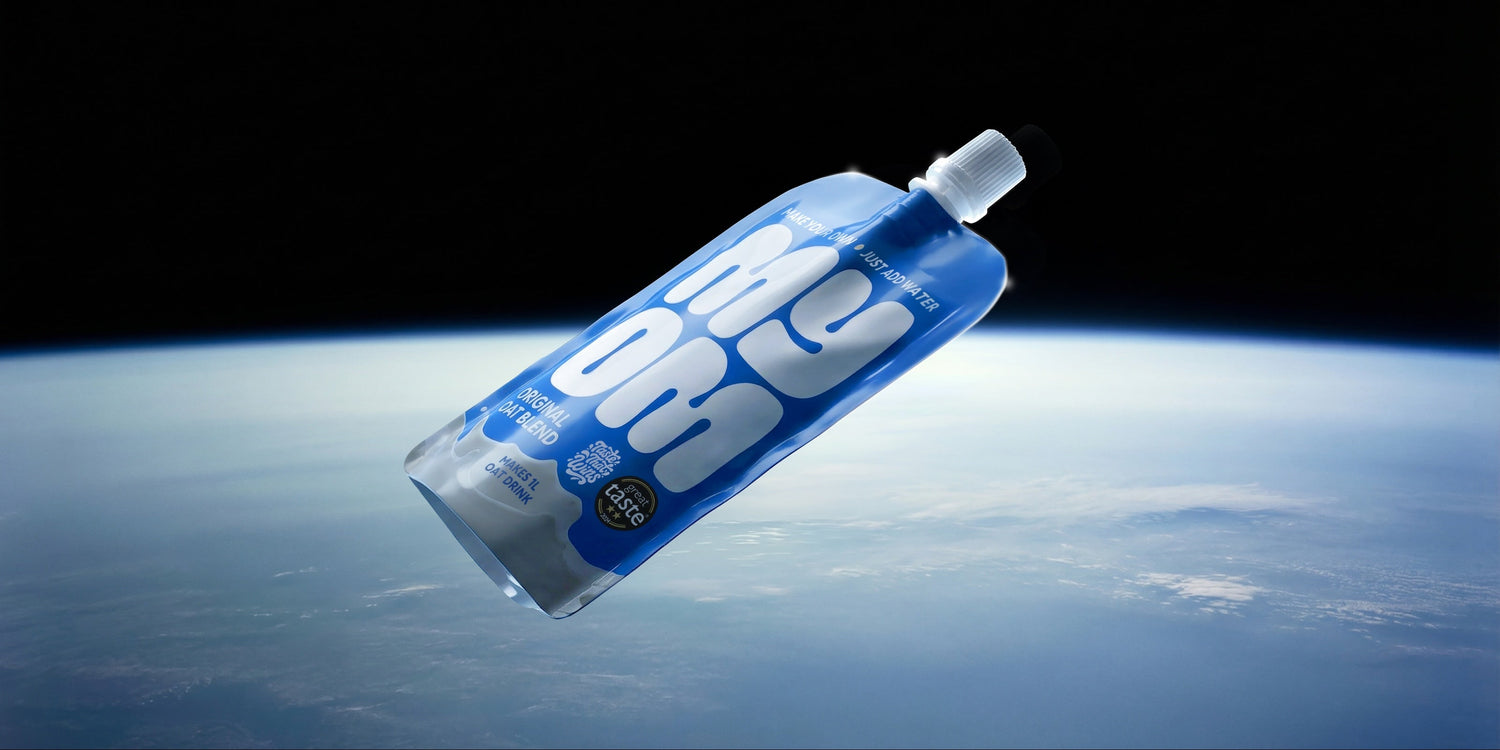
We didn’t set out to build space food. We set out to build better oat milk. But somewhere along the way, we noticed something funny: we’d arrived at exactly the same answer as NASA.
Since the earliest days of crewed spaceflight, one rule has held above all others: don’t ship water. Water is heavy. It’s bulky. And wherever you’re going, whether that’s the International Space Station or your kitchen, it’s usually already there when you arrive.
That simple insight shaped every food system from Mercury through Apollo. It gave us freeze-dried meals, rehydratable coffee, and in 1962, a powdered orange drink called Tang that became one of the most famous products in the history of space food. Not because it was delicious (it really wasn’t). But because it was light.
Sixty-odd years later, commercial space is booming. SpaceX is building Starship to carry humans to Mars. Blue Origin is developing commercial space stations. Virgin Galactic has taken paying passengers into space. The question of how to feed people beyond Earth has gone from science fiction to engineering brief.
And the founding principle hasn’t changed one bit: don’t ship water.
Sound familiar? It should. It’s precisely what MYOM does.
What if your oat drink had to earn its place on a rocket?
Here’s a thought experiment. Launch costs have dropped dramatically in the last decade. SpaceX’s Falcon 9 can put a kilogram into low Earth orbit for roughly $2,600, down from $65,400 in the Space Shuttle era. But even “cheap” in space terms is still eye-watering on Earth. Every gram matters.
Now pick up a standard litre of oat drink. It weighs about one kilogram. Of that, 850–900 grams is water. The oats, the calcium, the vitamins, the minerals, the actual nutritional value, all squeezed into the remaining 100–150 grams. You’re essentially shipping a kilogram to deliver 130 grams of useful product.
On a supermarket shelf, that inefficiency hides in plain sight. On a rocket? It’s a non-starter. And honestly, it shouldn’t be hiding on the supermarket shelf either.
Oats to Mars: 130 kilograms versus one metric tonne
Let’s take this somewhere more extreme. A crewed mission to Mars is estimated at roughly 1,000 days: six months there, eighteen months on the surface, six months back. No resupply runs. No popping out for milk. Everything the crew needs for nearly three years must launch with them.
If a crew member wants a litre of oat drink each day (and who could blame them?), conventional cartons would mean packing 1,000 litres. That’s approximately 1,000 kilograms. A metric tonne. Of mostly water.
With MYOM’s premix, the same supply weighs 130 kilograms. That’s 870 kilograms saved on oat milk alone. At current commercial launch rates, that weight saving works out at roughly $2.3 million in avoided launch costs per crew member.
We appreciate that “saves $2.3 million on your Mars mission” isn’t going on the pouch any time soon. But the principle is the same whether you’re loading a Falcon 9 or an Amazon delivery van. Less weight, less cost, less waste, more room for the things that matter.
|
Metric |
The Comparison |
|
Conventional oat drink |
1,000 litres = ~1,000kg (1 tonne) |
|
MYOM premix |
1,000 × 130g = 130kg |
|
Weight saved |
870kg per crew member |
|
Volume saved |
65% less storage space |
|
Launch cost saved |
~$2.3m at Falcon 9 LEO rates |

Tang was the best the sixties could do. What comes next?
Tang is the space food product everyone knows. General Foods created it in 1957; NASA adopted it for John Glenn’s Gemini missions in 1962. The association made Tang famous. But let’s be honest about the product: sugar and fructose were its first two ingredients. It solved the weight problem by spray-drying everything into powder. The taste and nutrition were … acceptable trade-offs for the era.
Spray-drying was the technology of its time. Powdered milk became vital for wartime rations, “Klim” for Allied troops, “National Dried Milk” in the UK. By the 1960s, industrial spray-drying was the standard method for turning any liquid food into something shelf-stable and lightweight. Effective, yes. But energy-intensive, destructive to flavour, and unkind to nutrients.
MYOM doesn’t spray-dry. We don’t freeze-dry. We don’t make a powder at all. Our premix is a concentrated liquid blend. Shelf-stable, lightweight, and designed to have a fresher taste when you add water. Because the oats have never been thermally blasted into dust and reconstituted, the taste, the mouthfeel, the texture they’re all fundamentally better than any powder format can achieve. Carton oat milks are engineered for shelf life, not flavour. Heat-treated, stabilised, and often dull by the time you drink them, while MYOM is made fresh, so it tastes fresh with a light oat taste.
Same principle as Tang. Better execution by about sixty years. No spray-drying energy cost. No powder rehydration challenges. No sugar-first ingredient list. Just concentrated oats, a short list of functional ingredients, and water added by you, wherever you happen to be.

Space-grade nutrition (without the space-age processing)
Weight is only half the story. The other half is what the product delivers when it arrives. And this is where it gets properly interesting.
Long-duration spaceflight creates specific nutritional challenges that aerospace medicine has studied extensively. Astronauts in microgravity lose bone mineral density at 1–1.6% per month, roughly ten times the rate of osteoporosis on Earth. The proximal femur alone can lose 1.5% of its mass every month, and recovery after a six-month mission takes three to four years. That’s a serious problem. NASA recommends approximately 1,000mg of calcium per day during missions, alongside 800–1,000 IU of vitamin D, to fight bone loss.
Here’s the thing: many astronauts also experience lactose intolerance or reduced calcium absorption in microgravity. So, a dairy-free, plant-based calcium source isn’t a lifestyle choice in space. It’s a practical nutritional solution.
Now look at what’s already in a pouch of MYOM:
The fortification that happens to match the brief
Calcium: 130mg per 100ml (16% of your Reference Intake), that’s more than semi-skimmed cow’s milk and more than Oatly, Alpro or Moma. If you drink a litre a day, that’s 1,300mg of calcium. NASA’s daily recommendation is 1,000mg. You’d be ahead of the astronauts.
Vitamin D3: On the ISS, there’s zero natural sunlight for skin synthesis. Astronauts’ vitamin D levels drop significantly even with supplementation. D3 is included in MYOM as standard — because it matters whether you’re in orbit or just in Scotland in January.
Vitamin B12: Critical for red blood cell formation and neurological function. Long-duration spaceflight alters blood chemistry, reduced red blood cell counts, iron metabolism changes. B12 from a clean, plant-based source supports blood health without dairy dependency.
Iodine: Supports thyroid function, which regulates your metabolism. Directly relevant in microgravity, where the body’s systems are adapting to a fundamentally different physical environment. Relevant on Earth too, especially if you’ve moved away from dairy and iodised salt.
Clear label. Short ingredient list. Calcium, D3, B12 and iodine in a lightweight, shelf-stable format. We designed it for your kitchen. It just happens to tick every box on a space nutrition brief.
On calories, fat and sugar: every gram earns its place
One thing to be honest about: low calorie isn’t straightforwardly an advantage in space. Astronauts commonly struggle to eat enough. Appetite drops, food fatigue sets in, and weight loss during missions is well documented. (Military research puts a hard limit of 21 consecutive days on MRE-only diets before menu fatigue seriously affects intake. Imagine that, but for three years.)
So MYOM’s 34 kcal per 100ml isn’t a selling point for energy in space. What it is, though, is efficient. At 1.9g of sugar per 100ml (compared to 3.3g for Oatly Whole or 4.7g for cow’s milk) MYOM doesn’t waste your caloric budget on sugar it doesn’t need. The serious calories can come from nutrient-dense meals; your oat milk shouldn’t be competing for that allowance. Low saturates (0.2g) keep the cardiovascular profile clean too, useful for astronauts under cardiovascular stress from fluid shifts in microgravity, and useful for you if you’d simply rather not.
The honest framing: MYOM doesn’t waste calories. Every gram works.
Back on Earth, the same logic is landing, hard
That principle matters in microgravity. It turns out it matters just as much with your feet on the ground. The rise of GLP-1 medications is accelerating a shift that was already underway: precision nutrition, where people eat less overall and care far more about what each calorie delivers. When your appetite is smaller, whether that’s because you’re orbiting Earth or because your body chemistry has changed, hidden sugars and unnecessary fats stop being minor irritations and start being the whole problem.
GLP-1 users tend to eat less but choose more carefully. Foods that are high in calories, sugar or fat without offering real nutritional value are often the first to go. Drinks play a bigger role than most people realise when appetite is reduced. A standard glass of oat milk at 61 kcal and 3.3g of sugar suddenly looks different when your entire daily intake has halved.
MYOM wasn’t designed for GLP-1 diets any more than it was designed for space. But 34 kcal per 100ml, 1.9g of sugar, 0.2g of saturates and a clean ingredient list put it on the right side of both conversations. When you’re choosing what earns a place in a smaller caloric budget, your oat milk probably shouldn’t be competing for that allowance with sugar it doesn’t need.
We’ve written a fuller guide to how oat milk fits with GLP-1 eating patterns — including a side-by-side nutritional comparison with every major brand: Is Oat Drink Compatible with GLP-1 Diets?
The people who saw it first
We’ll admit something: when we first started talking about the parallels between premix oat milk and space food logistics, we half expected people to think we’d lost the plot. An oat milk company drawing comparisons to NASA? That’s a stretch, surely.
But some people didn’t blink. In fact, they leaned in.
Three of MYOM’s shareholders and advisors happen to come from backgrounds where “don’t ship unnecessary weight” isn’t a marketing insight, it’s an operational instinct they’ve carried their entire careers.
Will Whitehorn OBE was the founding president of Virgin Galactic and is now chairman of Seraphim Space Investment Trust: the world’s first listed SpaceTech fund. Stephen Attenborough was Chief Customer Officer at Virgin Galactic and now serves as Strategic Advisor and European Lead at Space Perspective, alongside a role on the Advisory Board of Space for Humanity. Steve Ridgway, former CEO of Virgin Atlantic, spent decades optimising payload, fuel and weight at commercial scale.
All three are MYOM advisors and investors. All three recognised the premix logic instantly. Not because we pitched them a clever analogy, but because when you’ve spent your career in environments where every kilogram matters you spot format efficiency the moment you see it.
What they share isn’t just a space connection. It’s a challenger-brand instinct: the belief that you should question inherited assumptions, that imagination counts for as much as convention, and that a better answer is always worth pursuing even when the existing one seems fine to everyone else. That’s the culture they came from. It’s the culture MYOM was built in.
And then there’s Amazon. Their Sustainability Accelerator selected MYOM specifically because the premix format reduces weight, volume and carbon cost in last-mile delivery. The same format advantage that saves money in an Amazon depot saves money, in principle, on a launch pad. Same maths. Different altitude.
The water is already there (wherever “there” is)
One of the most remarkable engineering achievements on the International Space Station, before its planned decommissioning at the end of 2030, is its water recycling system. The Environmental Control and Life Support System now achieve a 98% water recovery rate. It recycles urine, sweat, even breath moisture. The Brine Processor Assembly, added in 2021, squeezes the last usable drops from urine brine. (Glamorous work, but effective.)
The average person on Earth uses roughly 82 gallons of water per day. An astronaut on the ISS? About one gallon. Water in space isn’t scarce, it’s just precious, so it’s recycled with astonishing care. What’s genuinely scarce is everything else: the nutrients, the ingredients, the variety. The things that make food worth eating.
This is exactly where concentrated formats come into their own. The water is already in the system. What you need to deliver is the product; the oats, the fortification, the flavour. MYOM’s premix is designed around precisely this logic: send the concentrated ingredients, add water at the point of use.
On the ISS, that water comes from a recycling system. On a future Mars habitat, it might come from extracted Martian ice. In your kitchen, it comes from the tap. The principle works everywhere. The altitude is optional.
Back to Earth: why this matters in your kitchen
Space logistics is the extreme case that makes a universal principle visible. But you really don’t need a rocket to benefit from the same thinking.
Every litre of conventional oat drink that travels from a factory in Sweden or Belgium to a supermarket in Manchester or Glasgow is carrying roughly 850 grams of water that your tap could have provided. That water takes up lorry space, requires refrigeration (for chilled formats), adds to packaging, increases delivery costs, and generates emissions at every stage of the journey.
Premix eliminates that weight from the supply chain. Not as a theoretical sustainability claim — as a physical fact. 85% lighter. 65% less space. No cold chain required until you add water and make it fresh at home.
The same logic that NASA applied to feeding astronauts in 1962 — and that the next generation of commercial space companies is applying right now — works just as well for your weekly shop. Less weight, less waste, less cost, better oat milk. It’s not rocket science. (Well, it is. But it’s also just common sense.)
We’ve written a companion piece on what Europe’s 2026 food trends mean for oat milk and why the consumer data points in the same direction as the space data. Read it here: EU Food Trends 2026: Why Better Oat Drink Starts Without Water.

First oat drink in space?
We’d be lying if we said we hadn’t thought about it.
Our format is shelf-stable, lightweight, compact, fortified with the nutrients space agencies specify for long-duration missions, and designed to mix with whatever water source is available. It doesn’t need refrigeration. It doesn’t need cooking. It doesn’t need special equipment. It fits in a crew member’s hand.
When three of your shareholders and advisors spent their careers getting things into space, the conversation tends to drift that way. And honestly? We love that it does. Not because we think MYOM is about to appear on a SpaceX manifest (although we wouldn’t say no). But because the ambition keeps us honest. If your product is designed well enough for a Mars transit vehicle, it’s certainly designed well enough for a flat in Hackney, a café in Edinburgh, or an Amazon depot in Hemel Hempstead.
Don’t ship water. Add it where you are. Make it fresh. That’s not rocket science. Well, it is, a little bit. But it’s also just a better way to make oat drink.
Try the oat drink that doesn’t ship water
MYOM’s Original Oat and Barista Oat premixes are available now. 85% lighter than cartons, 65% less space, and fortified with calcium, D3, B12 and iodine. Just add water and shake.
Keep reading:
• EU Food Trends 2026: Why Better Oat Milk Starts Without Water
• Is oat milk compatible with GLP-1 diets?
• How to choose the best oat drink UK 2026
• Is premix oat drink cheaper?
Data Sources & Attributions
External citations: NASA bone density research (NASA HRP), ISS ECLSS water recycling specs, SpaceX Falcon 9 payload pricing, EIT Food Consumer Observatory 2026, Seraphim Space Q3 2025 data