

We’re not here to argue about what to call it. We’re here because we rethought how to make it.
Open your fridge. If you’re in a third of UK households, there’s a carton of cow’s milk on one shelf and a carton of oat drink on another. Maybe almond. Maybe soy. You bought them both. You know which is which. Nobody in the history of the weekly shop has poured oat drink on their cereal and thought, hang on, where’s the cow? Yet somewhere between your kitchen and the Supreme Court, this became a legal question worth five years of argument.
In February 2026, the UK’s highest court confirmed that Oatly’s “Post Milk Generation” slogan can’t be trade-marked for oat-based food and drink because the word “milk” is a protected dairy designation. Headlines followed: “Oat milk banned!” “Plant-based loses the word milk!”
Except plant-based never had the word. Not in the UK. Not since 2013, and certainly not since the European Court of Justice confirmed it in 2017. Every oat brand on every UK supermarket shelf already says “oat drink” on the pack. Has done for years. The Supreme Court ruling was about a slogan, not a product name. And the consumers who buy both kinds? They were never confused. They were just getting on with breakfast.
So if the naming question was settled years ago, why is it still the loudest conversation in the category? And what happens when you look past it?
When Consumer Language and Legal Language Disagree
The oat drink naming debate isn’t unusual. It sits within a pattern as old as trademarks themselves: words become culturally generic while law remains precise. The two sides are solving different problems. Consumers optimise language for simplicity, familiarity, and cultural shorthand. Regulators optimise for protection, ownership, and competitive fairness. They’re both right. They will never move at the same speed. And in the gap between them, absurdity thrives.
Consider: around 22 million people in the UK say they “bank with Monzo” or “bank with Revolut.” Neither company started as a licensed bank. Both were Electronic Money Institutions. Yet the language moved years ahead of the licence. Consumers didn’t wait for regulatory approval to describe what they were doing. They were banking. The designation caught up later.
Or take “organic.” In food, it has a precise legal definition tied to agricultural certification standards. In skincare, shampoo, cotton it means whatever the brand wants it to mean. Consumers interpret it as “natural” regardless. Same word. Completely different legal weight depending on which aisle you’re standing in.
Or “Sellotape.” Everyone says it. Unless it’s made by Henkel, the trademark holder, it is legally not Sellotape and must not be called Sellotape. Nobody on Earth reaches for the sticky tape drawer and asks which brand it is. The word became the thing.
The oat drink question is the same pattern. Consumers say “oat milk.” The law says “oat drink.” The product doesn’t change either way. And the brands that navigate this well are the ones focused on what’s inside the packaging rather than what’s printed on it.
The Permitted and the Prohibited
If you’re going to spend a few minutes on the naming rules, you may as well enjoy the absurdity. The EU’s closed list of permitted exceptions, products allowed to use dairy terms despite not being dairy, is a tour of regulatory archaeology.
Coconut milk: permitted. Oat milk: prohibited. Absurd? It gets better.
Leche de Almendras (Spanish), Latte di Mandorla (Italian), Lait d’Amandes (French): all permitted. Almond milk (English): prohibited.
Same product. Different languages. The exceptions list is language-specific, based on traditional usage that individual member states applied to register. France, Spain and Italy applied. The UK never did.
More absurdity: Ice cream: designated dairy term. Non-dairy Ice cream: permitted.
And underpinning all of it, the legal definition of milk: “the normal mammary secretion obtained from one or more milkings.” That is the sentence doing the heavy lifting in a decade of litigation. Meanwhile, one in three UK households has both the mammary secretion and the oat drink in the same fridge and has never once mixed them up.
None of this is an argument that the law is wrong. The designations exist, they apply, and brands comply. But it is absurd to suggest that consumers are at risk of confusion. The IPO’s own hearing officer found exactly that in the Oatly case: consumers are not deceived. They know what they’re buying. The naming rules serve a different purpose.

The MILK-FREE Irony
The Supreme Court confirmed that strictly factual terms like “milk-free” and “dairy-free” are likely still permitted, because they clearly describe a product characteristic rather than borrowing the dairy category for branding. So, the regulation forbids you from writing “oat milk” on your pack but permits “milk-free oat drink.” The word “milk” ends up on the label either way, except now it’s positioned as the thing your product proudly isn’t. The consumer can pick up a pack that says MILK-FREE in large letters and think” ah, this is oat milk”. In some way, the designation rules haven’t removed the word. They’ve amplified it. And to understand the absurdity further, it helps to follow the ownership.
Follow the Ownership
Here’s where the naming conversation gets even more interesting. The UK’s biggest plant-based drink brands are not, for the most part, independent plant-based companies. They’re subsidiaries of dairy and drinks conglomerates. For example, Alpro, Silk and So Delicious are owned by Danone with Minor Figures part owned by the same company. Rude Health is owned by Valio, Moma by AG Barr, Plenish by Carlsberg Britvic and Jörd by Arla Foods.
Dairy UK, the trade body that brought the Oatly case, counts Arla Foods UK, Lactalis McLelland, Müller and Saputo among its members. Some of those same companies own or invest in the plant-based brands that the ruling now constrains. The industry is simultaneously acquiring plant-based brands and funding legal action to restrict how plant-based brands can market themselves. The absurdity is structural.
That’s how large food conglomerates manage portfolio risk. It’s rational. But it’s worth being clear-eyed about what the naming debate represents. The Supreme Court was explicit on this point: these restrictions apply even when consumers are unlikely to be misled. The purpose, the court said, is to maintain “fair conditions of competition” for the agricultural dairy industry. Not consumer protection. Fair competition. Whether strict designations that protect a multi-billion-pound industry from a £276 million one represents “fair competition” is a question worth sitting with. It’s a framework that disproportionately benefits the largest players, who can absorb regulatory complexity, over the smaller independent brands trying to reach the same shoppers.
MYOM is independently owned. We don’t have a dairy parent company hedging its bets. We don’t have a seat on Dairy UK’s board. What we have is a different format and the freedom to say what we think about it.
The Monzo Question
There’s a useful parallel outside food. A decade ago, incumbent banks were the undisputed owners of the word “bank.” Regulation required it: if you wanted to call yourself a bank, you needed a banking licence with full deposit-taking permissions. Challenger fintech’s like Monzo and Revolut started as Electronic Money Institutions, legally ‘not banks’ but functionally doing everything people wanted a bank to do.
Regulation protected the terminology. The incumbent response was familiar “you’re not a bank” and “you can’t say you’re a bank”. Consumers might be confused. The same playbook. The same absurdity. Consumers were not confused. They knew exactly what Monzo did. They knew it was better for their daily needs than the high-street branch that closed at 4pm. They called it their bank regardless. Eventually, the challengers got full licences. The language caught up. The incumbents were left defending a word while the market moved underneath them.
The dairy designation debate has the same structure. The product that consumers want and increasingly choose, already exists. One in three UK households buys plant-based alternatives. Oat is the most popular, accounting for roughly 40% of the plant drinks market. Seventy-two percent of millennials are consuming plant-based drinks. Gen Z dairy usage dropped from 79% to 73% in a single year. The cultural shift isn’t coming. It’s here. And the word on the label isn’t what’s driving it.
What Actually Matters?
If the name doesn’t matter, and it doesn’t, because nobody chooses an oat drink based on whether the label says “milk” or “drink”, then what does?
It helps to separate four things that often get tangled: the product (what’s in a pack), the product description (what the label says), the branding (how a company talks about it), and the format (how the product is designed to reach you and how you use it). The naming debate lives entirely in the second and third categories. The first and fourth are where the real choices happen.
The dominant format in the oat drinks category, factory-made liquid in a cartons, was inherited from dairy. It assumes the only place to add water is the production line. That assumption means every litre is 85–90% water, manufactured centrally, shipped heavy, and stacked on a shelf carrying weight that the consumer’s tap could have provided.
Powders solve the weight problem but create others: spray-drying is energy-intensive, the taste suffers, the texture can be grainy. Any benefit from emissions savings from reduced transport weight is far outweighed by the impact of the energy used to remove water. It’s a different compromise, not a better one.

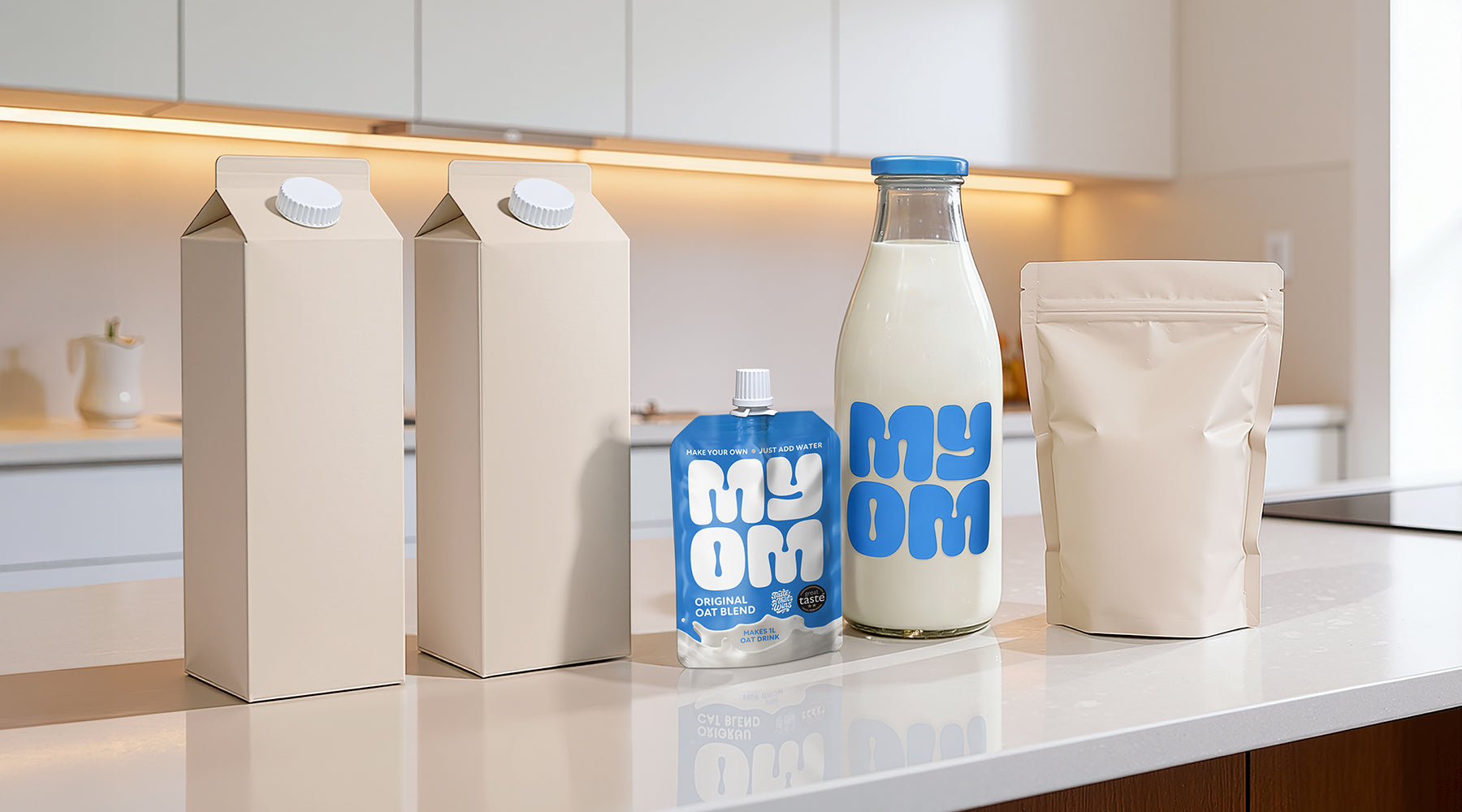
When we designed MYOM, the question wasn’t what to call it. It was how to get it to you. A concentrated liquid premix, not a powder, not a carton of water, that’s shelf-stable, lightweight, and designed to taste right when you add water at home. The same product. Eighty-five percent lighter. Sixty-five percent less space. No cold chain until you make it fresh. The format isn’t an afterthought. It’s the whole design: the product, the packaging, the delivery, the moment you shake it and pour. That’s what we spent our time on while the rest of the category was arguing about a word.
|
Curious how the cost per litre compares? |
A Category in Motion
The demographic data tells a clear story. Plant-based adoption is skewed toward younger, urban, female consumers. It’s driven by health, environmental concern and animal welfare in that order. But here’s the detail that matters most: 80% of households that buy plant-based also continue to buy dairy. This isn’t replacement. It’s addition. Flexitarians don’t need to be converted. They’ve already decided. They just need a better oat drink.
“Better” in 2026 means something specific. The EIT Food Consumer Observatory’s latest research confirms it: affordability now outranks sustainability as a purchase driver across Europe. Consumers want shorter ingredient lists, credible environmental claims and a lower cost per litre. They’ve stopped rewarding aspiration and started rewarding efficiency.
Popular culture is accelerating this. The pace of change in food, like finance, like media, is now set by culture, not by institutions. Regulation follows. It always has. The dairy designation rules were written for a world where plant-based drinks were a niche curiosity. One in three UK households has moved on. The rules will catch up eventually. The absurdity of fighting over a word while the market reshapes itself is not lost on anyone, is it?
|
We wrote a companion piece on what Europe’s 2026 food trends mean for oat drinks: EU Food Trends 2026: Why Better Oat Milk Starts Without Water |
The Oats Don’t Mind
We’ve never called MYOM “oat milk” on our packs. We say “MYOM OAT IS A BLEND OF OATS TO MAKE AN OAT DRINK BY ADDING WATER”. MYOM is an oat drink premix you shake to make fresh at home. That’s always been the product and always been the point.
The naming rules exist. We comply. Consumers still say “oat milk” and probably always will, the same way everyone said “I bank with Monzo” years before Monzo had a banking licence. Language moves at the speed of culture. Regulation moves at the speed of institutions and, honestly, it’s not our problem to solve.
Our problem is making the best possible oat drink and delivering it in a format that doesn’t ship water around the country for no reason. That’s the work we care about.
Call it what you like. We’ll be in the kitchen, shaking.
Ready to try the format, not the argument?
MYOM is available as Original Oat and Barista Oat. 85% lighter than cartons, short ingredient list, fortified with calcium, D3, B12 and iodine. Just add water and shake.

Keep reading:
• EU Food Trends 2026: Why Better Oat Drinks Start Without Water
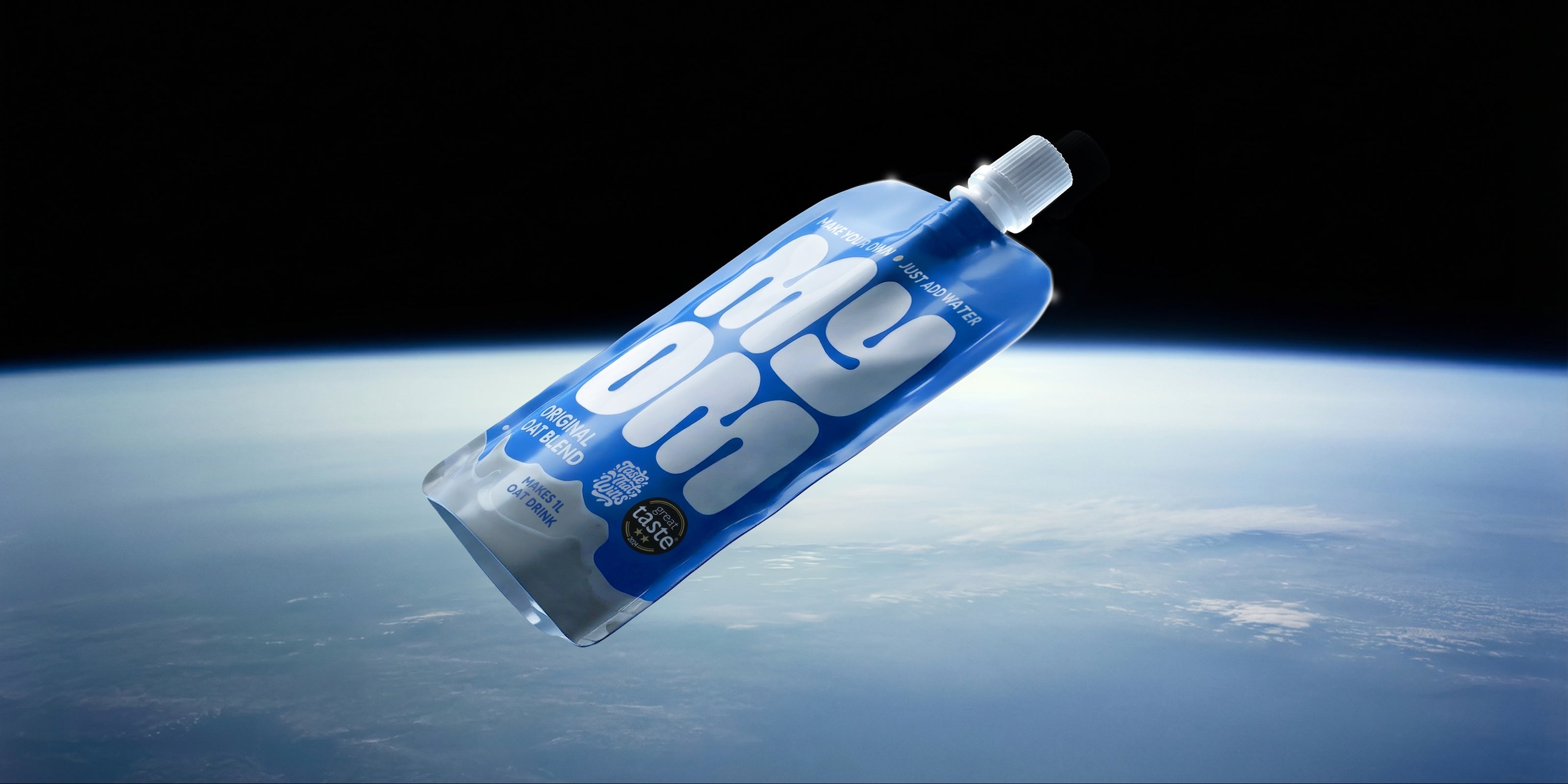
• MYOM to Mars: What Space And Your Oat Drink have in Common
• How to choose the best oat drink UK 2026
• Is premix oat drink cheaper?
Data Sources & Attributions
External citations: Supreme Court ruling: Dairy UK v Oatly [2026] UKSC 4 (11 Feb 2026). TofuTown ruling: CJEU Case C-422/16 (14 Jun 2017). EU Regulation 1308/2013, Annex VII Part III. Commission Decision 2010/791/EU, Annex I (exceptions list). Almond milk language-specific exception: USDA GAIN Report EU-28 (Jul 2017) confirms “lait d’amandes” (FR), “leche de almendras” (ES), “latte di mandorla” (IT) listed; English “almond milk” not listed. IPO hearing officer finding on consumer non-confusion: O/0049/23, para 33. Dairy UK members: Arla Foods UK, Lactalis McLelland, Müller, Saputo. Dairy farm decline: AHDB data, 7,010 farms (record low), down ~85% from ~46,000 in 1980. Plant-based market: GFI Europe data, £276m (+24% 2020–2022), 7% market share, forecast >£850m by 2029. EIT Food Consumer Observatory 2026 (affordability > sustainability as driver). Greenpeace/Unearthed: Dairy UK lobbying for stricter enforcement since 2017. Monzo/Revolut: originally EMIs (Electronic Money Institutions), not licensed banks. Monzo received full UK banking licence Jul 2017. Monzo ~12m UK customers, Revolut est. ~10m