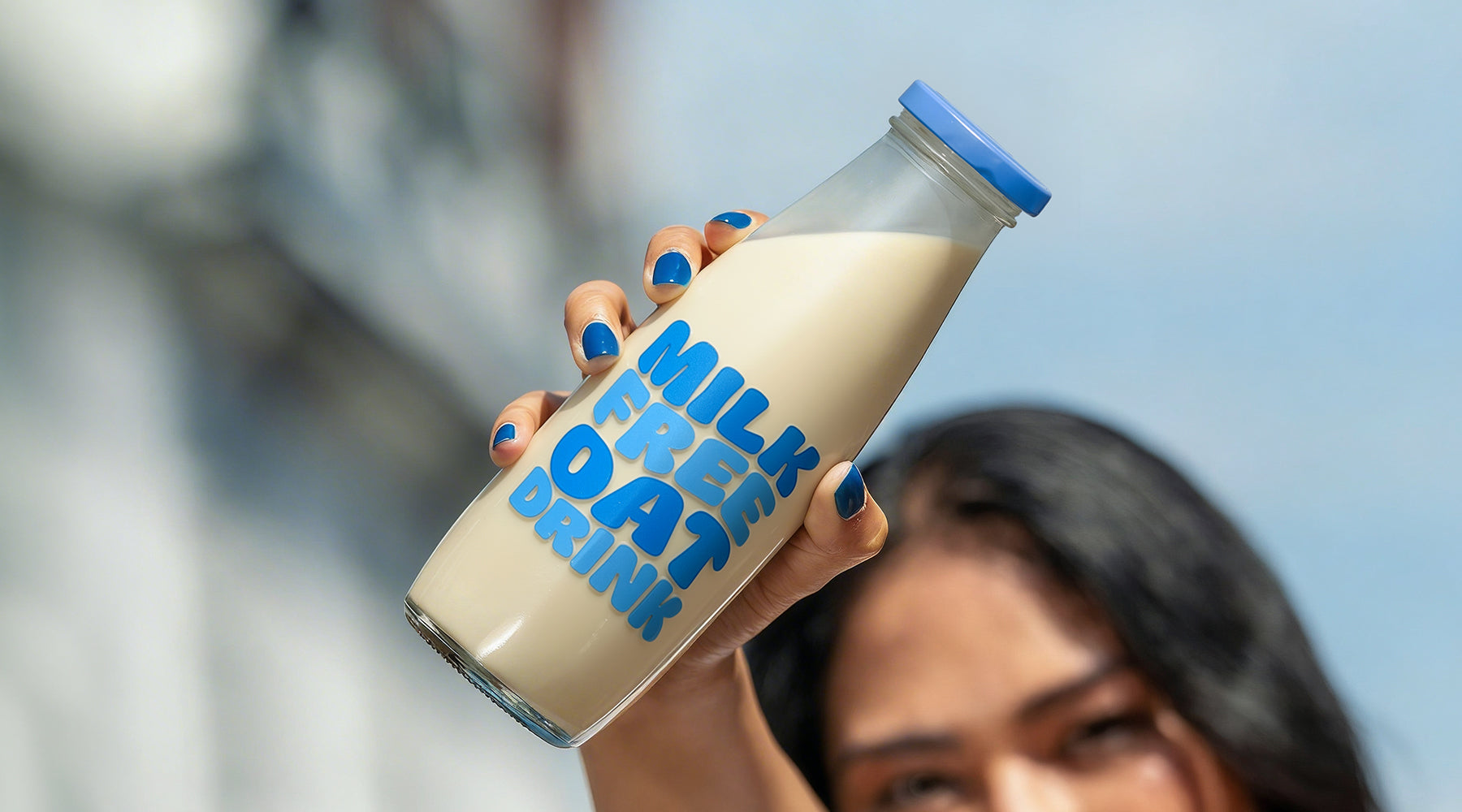

The word ‘milk’ was removed from oat drink packaging years ago. The Supreme Court just spent five years on a slogan that used it anyway. But while everyone was focused on the front of the pack, the back of the pack was telling a more interesting story.
Last week we wrote about the naming question. Oat drink, oat milk, milk-free: the words on the front of the label. The labelling rules have been in place since 2013, confirmed by the European courts in 2017: “milk” is reserved for animal dairy, and every oat brand in the UK has complied for years. The Supreme Court’s February 2026 ruling was about something narrower, whether Oatly could register “Post Milk Generation” as a trademark. They couldn’t. The headlines flared, but the product labelling hadn’t changed. The naming debate was settled long ago.
But while the front of the pack was getting all the attention, the back of the pack has been getting quietly more interesting. Because the next conversation in this category isn’t about what you call an oat drink. It’s about what’s in one.
Ultra-processed foods, UPFs, have moved from academic debate to front-page news. More than half the calories purchased by UK households come from ultra-processed food. The UK ranks among the worst in Europe. On 5 January 2026, HFSS advertising restrictions came into force, banning paid ads for foods high in fat, salt or sugar before 9pm on television and online at any time. UKRI’s year-long public dialogue on UPFs is due to report its findings imminently. California has passed legislation restricting UPFs in schools. San Francisco is suing ultra-processed food companies. The conversation has shifted from “should we worry about this?” to “what are we going to do about it?”
And here’s the part that should interest anyone buying oat drinks: a BMJ study on the overlap between HFSS-classified foods and ultra-processed foods in the UK diet found that ‘plant-based milks frequently appeared as UPFs that were not classified as HFSS’. They sit in a regulatory blind spot, ultra-processed by formulation, but invisible to the nutrient-based rules designed to flag unhealthy products. The category that markets itself as the healthier choice may not survive the next wave of ingredient scrutiny unchanged.
What’s Actually in an Oat Drink?
Not an opinion. A label read. We picked up six oat drinks from UK supermarket shelves; three standard, three barista and wrote down what’s on the back of the pack. Then we put our own next to them.
Standard Oat Drinks
| Oatly Original | Alpro Oat No Sugar | Sainsbury’s Oat | MYOM Original | |
|---|---|---|---|---|
| Oats | 10% | 8.3% | 10% | 80%* |
| Water | Primary ingredient | Primary ingredient | Primary ingredient | You add it |
| Oil | Rapeseed | Sunflower | Sunflower | Rapeseed |
| Acidity regulator | Dipotassium phosphate | — | Dipotassium phosphate | None |
| Stabiliser / Gum | — | Gellan gum | Gellan gum | None |
| Additional fibres | — | Soluble corn fibre | — | — |
| Fortification | Calcium, iodine, D2, riboflavin, B12 | Calcium, B2, B12, D2 | Calcium, iodine, B12, D | Calcium, iodine, B12, D3 |
| Salt | Salt | Sea salt | Sea salt | Sea salt |
| Total ingredients | 7 | 8 | 8 | 6 |
Barista Oat Drinks
| Oatly Barista | Alpro Barista Oat | ASDA Barista Oat | MYOM Barista | |
|---|---|---|---|---|
| Oats | 10% | 10% | 10% | 77%* |
| Water | Primary ingredient | Primary ingredient | Primary ingredient | You add it |
| Oil | Rapeseed | Sunflower | Rapeseed | Rapeseed |
| Protein boost | — | Pea protein | — | Fava bean protein |
| Acidity regulator | Dipotassium phosphate | Potassium phosphates | Potassium phosphates | None |
| Stabiliser / Gum | — | — | Gellan gum | None |
| Additional fibres | — | Chicory root fibre | Chicory root fibre | — |
| Fortification | Calcium, iodine, D2, riboflavin, B12 | B2, D2 | Calcium, iodine, B2, B12, D | Calcium, iodine, B12, D3 |
| Salt | Salt | Sea salt | Salt | Sea salt |
| Total ingredients | 7 | 7 | 10 | 7 |
*MYOM’s oat percentage is before dilution. As a concentrated premix, MYOM is 77–80% oats in the pouch. You add water at home at roughly a 7:1 ratio (130g premix makes 1 litre). The finished drink has a comparable oat percentage to cartons (~10–11%). The difference is that every carton on this table shipped that water from a factory. MYOM ships the oats. You add the water.
The tables tell a clear story. Every carton brand uses at least one additive that MYOM doesn’t: either an acidity regulator (dipotassium phosphate or potassium phosphates), a stabiliser (gellan gum), or both. Some add fibres (soluble corn fibre, chicory root fibre) that aren’t present in the oats themselves. These additives are what push a product into NOVA Group 4 ultra-processed.
All of these products make a perfectly good oat drink. None of these additives, in the quantities used, are considered harmful. This is not an argument that carton oat drinks are dangerous. It’s an observation about what the format demands.
Why Format Drives Formulation
A litre of oat drink in a carton is 85–90% water. It’s made in a factory, filled into packaging, and shipped to a warehouse, then a shop, then your kitchen. Between production and consumption, that liquid needs to remain stable. No separation, no sedimentation, no microbial growth, consistent texture and taste. For weeks. Sometimes months.

That’s a significant engineering challenge. Oats and water don’t naturally want to stay mixed. The starch settles. The oil separates. The pH drifts. Left alone, a carton of oat drink would separate into layers within days. So, the format demands intervention: acidity regulators to manage pH and prevent separation, stabilisers and gums to maintain texture and suspension, and in some products, additional fibres to improve mouthfeel that the dilution has diminished.
These are not the choices of careless brands. They’re the logical consequences of a format that asks a dilute liquid to remain stable over long periods of time. The brands using them are solving the problem the format creates. The question is whether the format itself is the right starting point.
A concentrated liquid premix changes the equation. Because the water is added at home, the product in the pouch is dense and stable by nature; 80% oats, not 10%. There’s no dilute suspension to manage. No weeks-long shelf-stability problem to solve with additives. You make it fresh, you use it within days, and the physics of keeping oats in water simply don’t require the same interventions. The format doesn’t ask for acidity regulators, so there are none. It doesn’t ask for stabilisers, so there are none.
The ingredient list is a consequence of the format. Change the format, and the ingredient list changes with it.
A note on phosphates
MYOM Barista contains tricalcium phosphate. Carton brands contain dipotassium phosphate or potassium phosphates. Similar-sounding, entirely different. MYOM’s tricalcium phosphate is a mineral fortification. It’s how we deliver calcium. The carton brands’ phosphates are acidity regulators, their function is pH management to prevent separation. Similar name. Different job. We mention this because ingredient literacy matters, and part of reading a label well is understanding not just what’s in a product but why it’s there.
A note on rapeseed oil
You'll notice rapeseed oil appears in several of the ingredient lists above. Ours, Oatly’s, and ASDA’s. If you’re aware of the seed oil debate, mostly originating in the US, it’s worth a brief note. The concern centres on omega-6 fatty acids, which in excess may promote inflammation. But not all seed oils are equal. Rapeseed oil has one of the lowest omega-6 to omega-3 ratios of any common oil, roughly 2:1. Sunflower oil, used by Alpro and Sainsbury’s in the tables above, sits at approximately 246:1. The anti-seed-oil argument, applied consistently, is overwhelmingly an argument against sunflower oil, not rapeseed.
MYOM’s rapeseed oil is certified GM-free and Kosher. It’s not the hexane-extracted, industrially refined canola oil that drives US scepticism, that’s largely a North American phenomenon tied to GM herbicide-resistant varieties. UK and EU rapeseed oil is a different product, grown under different regulations, and viewed differently by health authorities on both sides of the Atlantic. We’ve written about this in detail: why we chose rapeseed oil and how EU and US perspectives differ.
But What About Powder?
If the problem is the carton format, the obvious next question is: why not remove the water entirely? Spray-dry the oats into a powder. Ship it light. Let the consumer rehydrate at home. Several brands are doing exactly this. On paper, it looks like the cleanest solution. In practice, the ingredient list tells a different story.
| Oat Drink Powder (typical) | MYOM Original Premix | |
|---|---|---|
| Format | Spray-dried powder | Concentrated liquid premix |
| Ingredients | Gluten-free organic oats, coconut MCT powder (corn fibre), chicory root fibre, calcium carbonate, vitamin B12 | OATS (80%), Water, Rapeseed oil, Minerals (Calcium carbonate, Potassium iodide), Sea salt, Vitamins (B12, D3) |
| Acidity regulator | None | None |
| Stabiliser / Gum | None | None |
| Process-driven ingredients | Coconut MCT powder (corn fibre), chicory root fibre | None |
| Spray-drying required | Yes. Up to 2,000 kWh per hour | No. Process skipped entirely |
The powder gets rid of the gums and the acidity regulators. That’s genuine progress. But the spray-drying process introduces its own demands. You can’t spray-dry liquid oil into a powder, it won’t survive the process. So, you need an encapsulation medium: coconut MCT powder, carried on corn fibre, is there to do a job that whole rapeseed oil does naturally in a liquid premix. The chicory root fibre is a bulking agent, replacing the body and mouthfeel that whole oats provide in liquid form but lose when spray-dried and reconstituted.
These aren’t harmful ingredients. But they’re not there because the product needs them. They’re there because the process does. The spray-drying format solves the weight problem of cartons but creates a different set of ingredient demands and a significant energy cost. An industrial spray dryer uses up to 2,000 kWh per hour of operation. The transport emissions saved by shipping a lighter product can be offset by the energy required to make it that light in the first place.
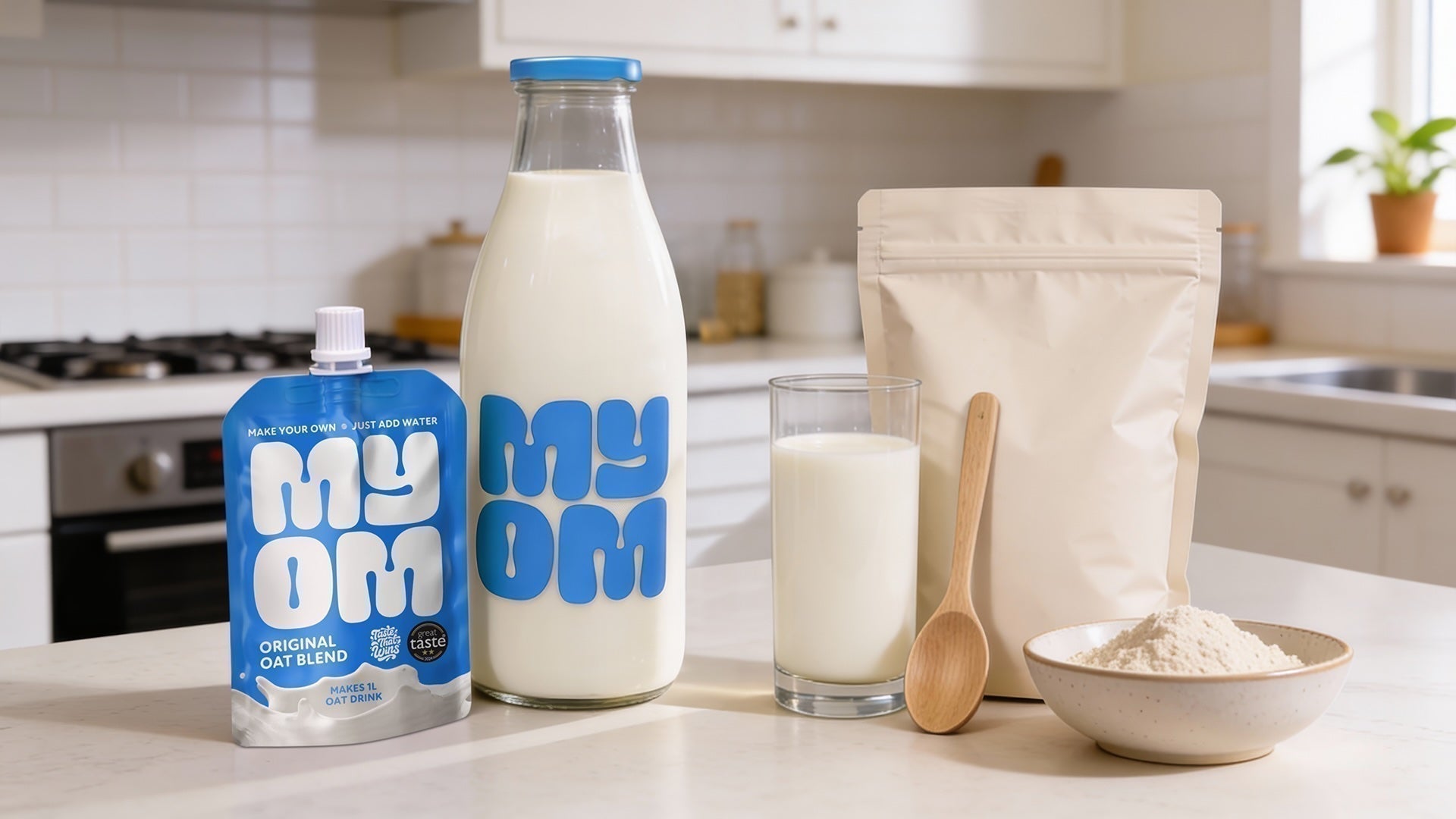
A concentrated liquid premix sidesteps both problems. It’s 85% lighter than a carton, so it captures the transport benefit. But because it’s never dried, it doesn’t need encapsulation media, fibre bulkers, or the energy-intensive conversion step. The oil stays as oil. The oats stay as oats. The format is lighter than a carton without the processing cost of a powder.
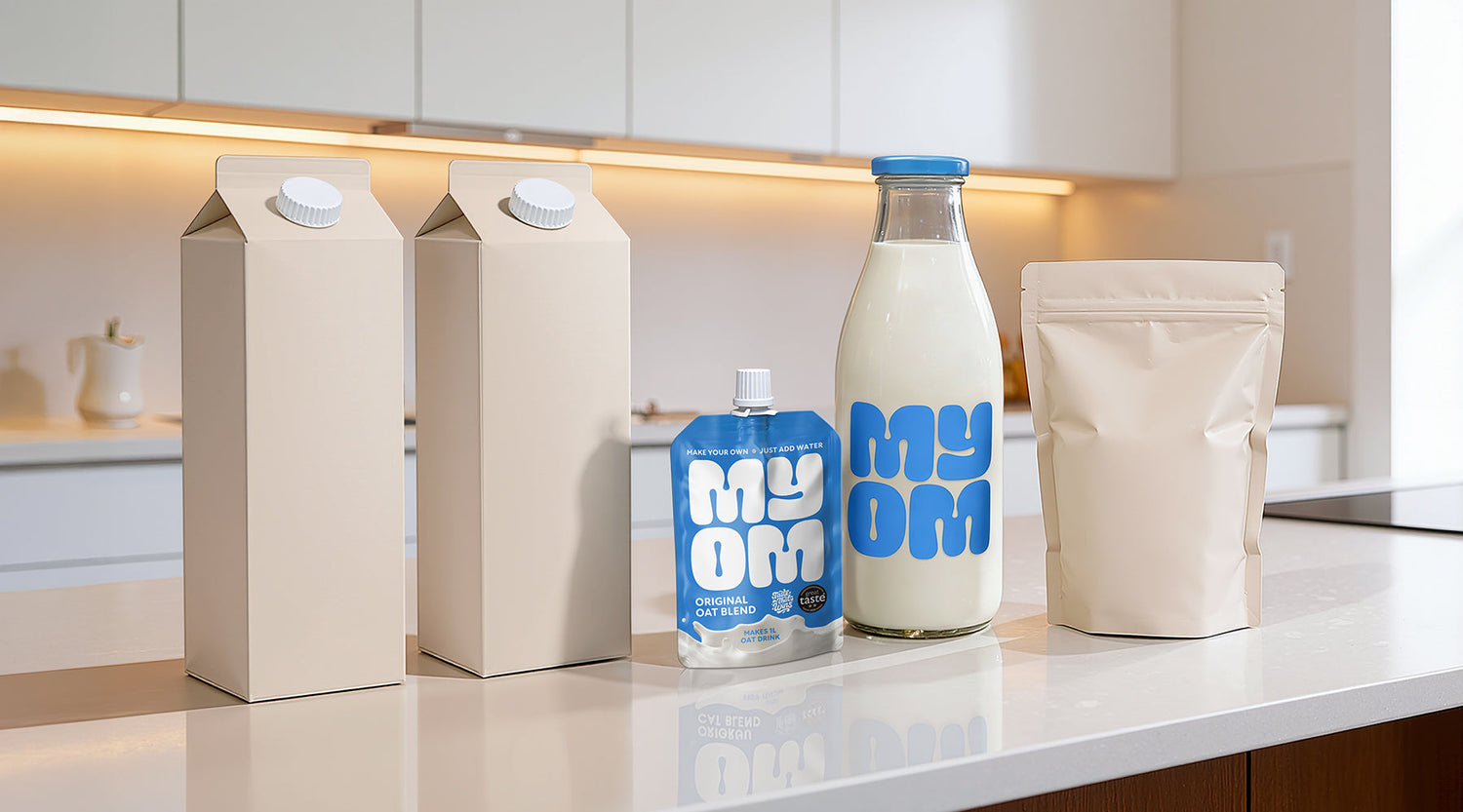
Three formats. Three ingredient stories. Cartons add additives to keep a dilute liquid stable. Powders add ingredients to survive the drying process. Premix doesn’t need either.
The Regulatory Moment
The UPF conversation is no longer theoretical. It’s entering regulation, procurement, and litigation.
In January 2026, the UK’s HFSS advertising restrictions came into force banning paid ads for products high in fat, salt or sugar before 9pm on television and online at any time of day. UKRI’s year-long public dialogue on UPFs, the first of its kind in the UK, is due to publish findings in early 2026. In the US, California has legislated to phase out certain ultra-processed foods from school meals. New York has mandated minimum whole-food requirements in public institution meals. San Francisco is suing ultra-processed food companies. The FDA and USDA have jointly launched their first formal Request for Information on defining UPFs. And the market is creating its own accountability: the Non-GMO Project, whose Butterfly label is recognised by millions of shoppers, has launched a Non-UPF Verified certification programme (nonultraprocessed.org), signalling that non-UPF status may be following the same trajectory as non-GMO, from activist concern to consumer-facing standard.
In the UK, the current policy framework relies on nutrient profiling (the HFSS model) rather than processing classification (NOVA). But research is revealing the gap. A BMJ study using over a decade of UK National Diet and Nutrition Survey data found that more than 40% of ultra-processed food products consumed in the UK are not captured by HFSS rules. Plant-based drinks were specifically identified as products that are ultra-processed by formulation but fall outside HFSS classification, a category that escapes both the nutrient-based and processing-based regulatory nets.
The science is still debated. Not all ultra-processing is equally concerning. Researchers disagree on whether NOVA is the right classification system, and the definitions are broad enough to include wholemeal bread and fish fingers alongside sugary drinks and reconstituted snacks. This piece is not claiming that oat drinks are unhealthy. It’s pointing out that the category is heading into a more ingredient-literate regulatory environment, and that brands whose formulations depend on industrial additives to solve format problems will face harder questions than brands whose formulations don’t.
A Familiar Pattern
If this feels familiar, it should. The naming debate and the UPF conversation share the same underlying structure: a format inherited from dairy, often owned by dairy, and carrying the engineering consequences of dairy-scale production.
The major oat drink brands in the UK, Alpro (Danone), Rude Health (Valio), Moma (AG Barr), Minor Figures (Danone Manifesto Ventures), are owned or part-owned by dairy or drinks conglomerates. They inherited the carton format. The long ingredient lists are a feature of that inheritance. The additives are there because the format demands them, and the format exists because that’s how the parent companies have always done it.
And the category is now responding in real time. In February 2026, Oatly added a “Trust the Processed” label to its UK cartons, arguing that food processing has been adopted by humans for centuries to reduce nutrient loss and improve affordability. It’s a bold move — but notice what it defends: the process, not the ingredient list. Industry commentators noted that consumer concern is more likely driven by unfamiliar ingredients like dipotassium phosphate than by heat treatment or homogenisation. MYOM’s answer to the same question is different: rather than asking consumers to trust the process, we changed the format so the process doesn’t need defending.
MYOM is independently owned. We didn’t inherit a format. We designed one around a different question: what if the consumer adds the water?
MYOM’s Ingredient List
No stabilisers. No emulsifiers. No acidity regulators. No gellan gum. No soluble corn fibre. No chicory root fibre. Not because we’re against them. Because we don’t need them. The format doesn’t ask for them.

Original Oat Drink Premix
Ingredients: OATS (80%), Water, Rapeseed oil, Minerals (Calcium carbonate, Potassium iodide), Sea salt, Vitamins (B12, D3).
Barista Oat Drink Premix
Ingredients: OATS (77%), Rapeseed Oil, Water, Fava Bean Protein, Minerals (Tricalcium Phosphate, Potassium Iodide), Sea Salt, Vitamins (B12, D3).
What Goes in the Pack Rather Than on It
The naming conversation was interesting. The formulation conversation is more so.
We set out to stop shipping water and made a non-UPF oat drink as a consequence of the format. A product development and proposition decision. It turns out that when you remove the need to stabilise a dilute liquid for weeks on a shelf, you remove most of the additives too.
As the UPF conversation moves from academic papers to advertising bans, procurement rules, and potentially litigation, every brand in the oat drinks category will face a simple question: is this ingredient here because the product needs it, or because the format does?
For MYOM, the answer is straightforward. Every ingredient is in the pouch because the product needs it. None are there to solve a problem the format created.
Keep reading:
• Oat Drink, Oat Milk, Same Fridge. Here’s What Actually Matters
• Is Premix Oat Drink Cheaper?
• EU Food Trends 2026: Why Better Oat Drinks Start Without Water
• MYOM Oat Drink and Rapeseed Oil. And Why We Chose It…
• Rapeseed Oil: Phat or Fat? EU vs US Sentiment
Frequently Asked Questions
Is oat milk ultra-processed?
Most commercially available oat drinks sold in cartons would be classified as ultra-processed under the NOVA Group 4 system. This is because they typically contain additives such as acidity regulators (dipotassium phosphate, potassium phosphates), stabilisers (gellan gum), and emulsifiers that are characteristic of industrial formulation. These ingredients are not inherently dangerous — they’re engineering solutions that keep a dilute liquid (85–90% water) stable on a shelf for months. Not all oat drinks are ultra-processed. MYOM’s premix format uses a short ingredient list with no stabilisers, emulsifiers, or acidity regulators because the concentrated liquid format doesn’t require them.
What ingredients are in oat milk?
Ingredients vary significantly by brand and format. A typical UK supermarket oat drink carton contains: water (85–90%), oats (8–10%), oil (rapeseed or sunflower), an acidity regulator (dipotassium phosphate or potassium phosphates), calcium carbonate, salt, and vitamins. Some also include stabilisers (gellan gum), fibre (chicory root fibre or soluble corn fibre), and protein (pea protein). MYOM Original premix contains: oats (80%), water, rapeseed oil, minerals (calcium carbonate, potassium iodide), sea salt, and vitamins (B12, D3). The difference in ingredient length is driven by format: a concentrated premix doesn’t need the additives that keep a dilute carton shelf-stable.
Why does oat milk contain gellan gum?
Gellan gum is a stabiliser used in some oat drink cartons to prevent the liquid from separating during its shelf life. When you dilute oats to 8–10% concentration and pack them in a carton designed to sit on a shelf for months, the solids and liquids tend to separate. Gellan gum keeps the mixture uniform. It’s a format-driven ingredient: it’s not there because the oat drink needs it for taste or nutrition, but because the carton format needs it for physical stability. Formats that aren’t pre-diluted, such as concentrated premixes designed to be shaken before use, don’t need stabilisers.
Are all oat drinks ultra-processed?
No. Ultra-processing is determined by formulation, not by category. An oat drink made from oats, oil, salt, and vitamins would not typically be classified as NOVA Group 4. It’s the presence of industrial additives; acidity regulators, stabilisers, emulsifiers, and ingredients like soluble corn fibre that can trigger the classification. The format of the product heavily influences whether those additives are needed. Cartons, which contain a dilute liquid designed for months of ambient shelf life, tend to require more of them. Formats like MYOM's oat premix don't need to keep water and oats suspended in a dilute liquid for months, so they don't need the additives designed to do that job.
What is NOVA Group 4?
NOVA is a food classification system developed by researchers at the University of São Paulo. It categorises foods into four groups based on the extent and purpose of processing: Group 1 (unprocessed or minimally processed), Group 2 (processed culinary ingredients), Group 3 (processed foods), and Group 4 (ultra-processed food and drink products). Group 4 is defined by the presence of ingredients not commonly used in domestic cooking such as emulsifiers, stabilisers, humectants, flavour enhancers, and other substances whose purpose is to make industrial formulations look, taste, and feel like minimally processed food. NOVA is increasingly referenced in public health research and policy, though its definitions remain debated among scientists and regulators.
What is the difference between oat drink and oat milk?
They’re the same product. EU and UK law reserves the term “milk” for animal dairy products; a rule in force since 2013 and confirmed by the European Court of Justice in 2017. All oat-based alternatives sold in the UK are labelled “oat drink” on pack. Consumers widely use “oat milk” in everyday language. The Supreme Court’s February 2026 ruling in Dairy UK v Oatly confirmed the restriction applies even to slogans, finding that Oatly’s “Post Milk Generation” trademark was invalid. We wrote about the naming question in detail in our companion piece: Oat Drink, Oat Milk, Same Fridge. [Insert link]
Is MYOM oat drink ultra-processed?
MYOM’s ingredient list does not contain the industrial additives like acidity regulators, stabilisers, emulsifiers, or flavour enhancers that characterise NOVA Group 4 classification. MYOM Original contains: oats (80%), water, rapeseed oil, minerals (calcium carbonate, potassium iodide), sea salt, and vitamins (B12, D3). Every ingredient would be recognisable to a home cook. The short ingredient list is a consequence of the format: a concentrated liquid premix doesn’t need the additives that a dilute carton requires for shelf stability. We set out to stop shipping water. The clean label followed.
Is oat milk powder ultra-processed?
Oat milk powders occupy a grey area. They typically avoid the stabilisers and acidity regulators found in cartons, but the spray-drying process introduces its own ingredient demands. Most oat powders use coconut MCT powder (a fat encapsulated in a carrier medium such as corn fibre) because liquid vegetable oils cannot survive spray-drying. Some add chicory root fibre for body and mouthfeel lost during drying. Whether these ingredients trigger NOVA Group 4 classification depends on interpretation, but they are process-driven and present because the format demands them, not because the product needs them for taste or nutrition.
What is coconut MCT powder in oat milk?
Coconut MCT powder is a spray-dried form of medium-chain triglyceride oil derived from coconut. In oat milk powders, it replaces the liquid vegetable oil (such as rapeseed or sunflower) used in cartons and premixes. Liquid oil cannot survive the spray-drying process, so it must be encapsulated in a solid carrier, typically corn fibre or similar, to convert it into a powder form. The result is a fat source that can exist as a dry ingredient. It’s not harmful, but it’s a process-driven substitution: it’s there because the format requires it, not because coconut MCT is nutritionally superior to rapeseed oil for an oat drink.
Is oat drink premix better than oat drink powder?
They solve the same problem, eliminating the shipped water in cartons, but make different trade-offs. Powder is lighter (fully dehydrated) but requires energy-intensive spray-drying, introduces process-driven ingredients (coconut MCT powder, fibre bulkers), and can affect taste and texture. Premix is a little heavier than powder but lighter than cartons (85% lighter), avoids the spray-drying step entirely, uses whole ingredients and preserves the taste profile of fresh oats. MYOM oat premix captures most of the transport benefit of powder without the processing cost. MYOM is the only oat drink to win a two-star Great Taste Award, which we think says something about the format and which is better.
Data Sources & Attributions
Regulatory & Legal: EU Regulation 1308/2013, Annex VII Part III (dairy designation rules, in force 2013). CJEU Case C-422/16 TofuTown (14 Jun 2017, confirmed plant-based products cannot use dairy terms). Dairy UK v Oatly [2026] UKSC 4 (11 Feb 2026, “Post Milk Generation” trademark refused). HFSS advertising restrictions: Health and Care Act 2022, secondary legislation; restrictions in force 5 January 2026 (DHSC/Ofcom). California Assembly Bill 2316 (2024, UPF restrictions in school meals). San Francisco v ultra-processed food companies (filed December 2025). FDA/USDA joint Request for Information on UPF definitions (2025).
UPF & NOVA Classification: NOVA food classification system: Monteiro CA et al., “Ultra-processed foods: what they are and how to identify them,” Public Health Nutrition, 2019. BMJ study on UPF/HFSS overlap: Sherif R et al., “Overlap between ultra-processed food and food targeted by nutrient profiling models,” BMJ Nutrition, Prevention & Health, 2023. UK household UPF calorie share: Rauber F et al., “Ultra-processed food consumption and indicators of obesity in the UK population,” BMJ Open, 2021 (>50% of household food purchases by calorie). UKRI UPF public dialogue: launched January 2025, findings due early 2026.
Ingredient Data: All ingredient lists sourced from product packaging and/or brand websites as of February 2026. Brands included: Oatly (oatly.com), Alpro (alpro.com), Sainsbury’s (sainsburys.co.uk), ASDA (groceries.asda.com), Overherd (overherd.uk), Kwerky (kwerkyfoods.com), Mighty (mightydrinks.com). Oat percentage concentrations from pack declarations. MYOM ingredient lists confirmed from current production labelling.
Energy & Processing: Spray-dryer energy consumption: UK Government Energy Efficiency Best Practice Programme (EEBPP), Baker & McKenzie, 2005 (average 4.87 GJ/t water evaporated, range 3–20 GJ/t). Industrial spray dryer power: up to 2,000 kWh/hour (manufacturer specifications for large-scale food production units). Energy waste in spray-drying: ~29% of energy supplied wasted (EEBPP survey). UK average household electricity consumption: 2,700 kWh/year (Ofgem Typical Domestic Consumption Values) / 3,449 kWh/year (DESNZ sub-national electricity data, December 2024).
Market Data: UK plant-based drinks market: GFI Europe, £276m (24% growth 2020–2022), 7% category share, forecast >£850m by 2029. One in three UK households buying plant-based: Kantar Worldpanel. Oat drinks ~40% of plant drinks market: Mintel UK Plant Milk Report. 72% of millennials consuming plant-based drinks: Mintel/GFI. Gen Z dairy usage decline 79% to 73%: Mintel UK Dairy Report 2024. EIT Food Consumer Observatory 2026 (affordability > sustainability as purchase driver). Brand ownership: Alpro/Silk/So Delicious (Danone), Minor Figures (Danone minority stake), Rude Health (Valio), Moma (AG Barr), Plenish (Carlsberg Britvic), Jörd (Arla Foods). Dairy UK members: Arla Foods UK, Lactalis McLelland, Müller, Saputo.
Functional Ingredient Notes: Dipotassium phosphate / potassium phosphates: acidity regulators used in oat drink cartons for pH management. Tricalcium phosphate: calcium source used in MYOM Barista for mineral fortification, not acidity regulation. Same phosphate family, different function. Gellan gum: polysaccharide stabiliser preventing phase separation in dilute liquids. Coconut MCT powder: medium-chain triglyceride oil encapsulated in carrier (typically corn fibre) for spray-drying compatibility. Chicory root fibre: prebiotic fibre used as bulking agent in some cartons and powders.