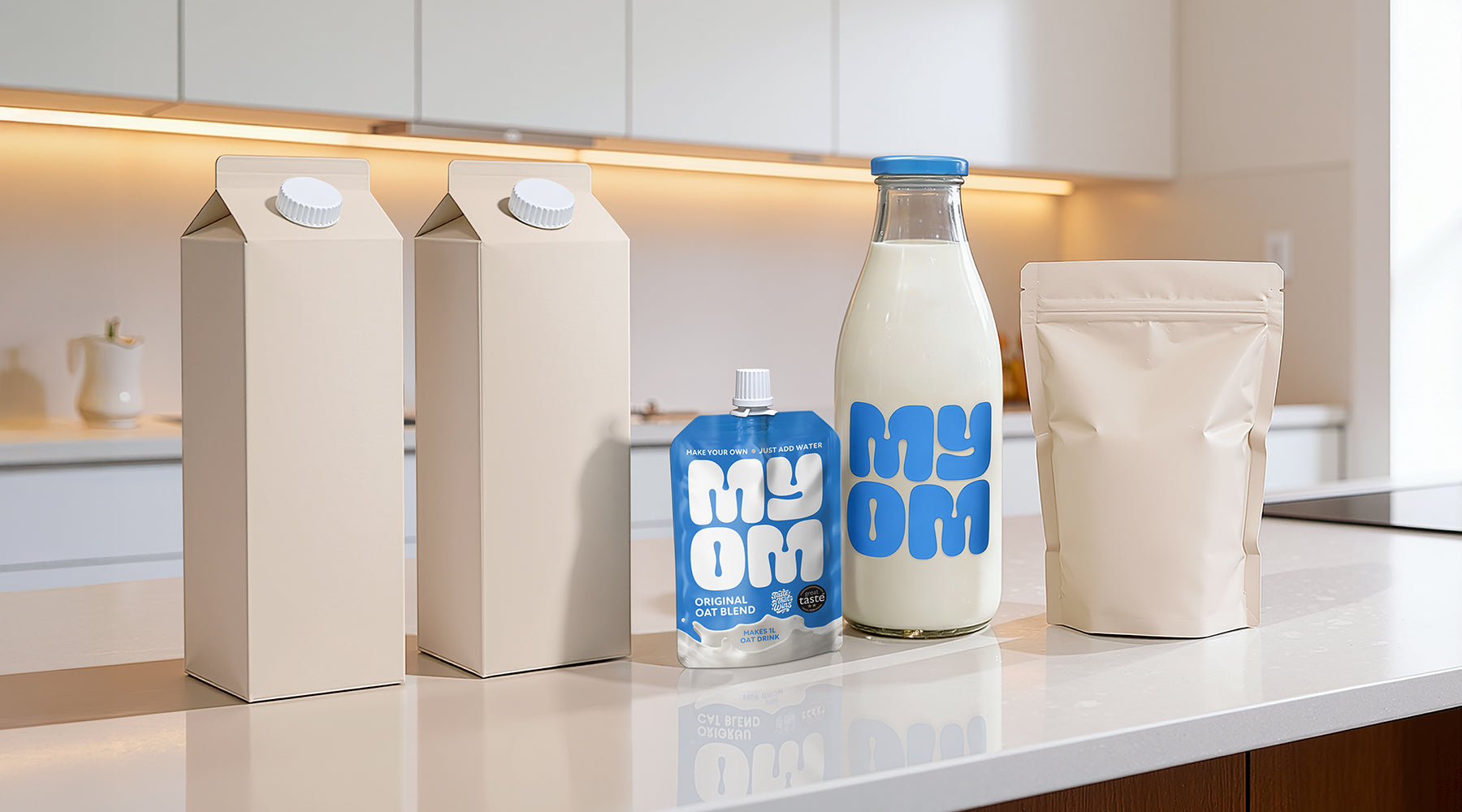


Over 90% of UK oat drinks are sold in liquid cartons, shipping up to 90% water from factory to fridge. Alternative formats are solving this inefficiency in different ways. Powders remove the water entirely through spray-drying, which can be energy-intensive and reshapes the ingredient list. MYOM takes a different route: liquid oat premix, skip the drying step, and people can still add the water at home. The real question isn’t powder versus premix, it’s how best to move beyond the carton.
If you’ve read our last two pieces, you know where we stand on cartons. Most oat drinks ship 90% water from a factory to your kitchen, often using acidity regulators and stabilisers to keep that water stable on its journey from factory to fridge. The format often determines the ingredient list. The format creates the transport cost. The format is the problem.
Two emerging formats are trying to solve this and they’re doing it in fundamentally different ways.
Oat drink powders spray-dry the liquid into a dry format. Ship it light. Let the consumer add water at home. It’s a logical idea. It eliminates the weight problem. It eliminates the need for liquid stabilisation. And on paper, it looks like the cleanest, greenest alternative to a carton.
MYOM Oat Drink premix takes a different route and is unique as a product in the category. Instead of drying the oats, MYOM is a concentrated premix using less than 85% of the water of a carton. With both options, people add water at home, but with MYOM our oat blend is never dried, heated in a spray chamber, or reconstituted. And the step in the middle is rarely discussed and doesn’t appear on the label.
| Oatly Original | Alpro Oat No Sugar | Sainsbury’s Oat | MYOM Original | |
|---|---|---|---|---|
| Oats | 10% | 8.3% | 10% | 80%* |
| Water | Primary ingredient | Primary ingredient | Primary ingredient | You add it |
| Oil | Rapeseed | Sunflower | Sunflower | Rapeseed |
| Acidity regulator | Dipotassium phosphate | — | Dipotassium phosphate | None |
| Stabiliser / Gum | — | Gellan gum | Gellan gum | None |
| Additional fibres | — | Soluble corn fibre | — | — |
| Fortification | Calcium, iodine, D2, riboflavin, B12 | Calcium, B2, B12, D2 | Calcium, iodine, B12, D | Calcium, iodine, B12, D3 |
| Salt | Salt | Sea salt | Sea salt | Sea salt |
| Total ingredients | 7 | 8 | 8 | 6 |
How Spray-Drying Works
To turn a liquid oat base into a powder, you spray-dry it. This is an industrial process in which the liquid is atomised into fine droplets and blasted with hot air in a large drying chamber. The water evaporates almost instantly. What’s left is a fine, soluble powder.
It’s a well-established technology, used across the food industry for decades. In the post-war years, spray drying became the dominant method for producing milk powder, driven by a surge in milk production and the need to manage surplus dairy products. It works well. The question isn’t whether it works. It’s what trade-offs the process creates compared to other ways of solving the same problem.
Spray-drying remains one of the most energy-intensive unit operations in food manufacturing. Industry figures show energy use of up to 7 kWh per kilogram of water removed, depending on the system, the product, and whether the liquid is pre-concentrated before drying.
The exact numbers depend on the scale of the operation, the evaporation rate, and whether the input is pre-concentrated using evaporators before it enters the spray dryer. Notwithstanding this, the direction is clear: the transport saving from shipping a lighter product is real, but it comes with a production energy cost that rarely appears in the sustainability conversation.
The weight powder saves in transport comes with a significant production energy cost in the dryer.
Different Formats, Different Ingredients
The two formats don’t just differ in how they’re made, they differ in what needs to be in the product.
In our UPF piece, we looked at what cartons add to solve shelf-stability problems: acidity regulators, stabilisers, gums. Powders don’t need those. That’s genuine progress. But spray-drying introduces its own ingredient requirements. Certain components of an oat drink don’t survive the process, so powder brands adapt their recipes accordingly.
The clearest example is fat. A liquid oat drink contains oil, rapeseed, sunflower, or similar for mouthfeel and body. You can’t spray-dry liquid oil. It won’t survive the process: the heat degrades it, and it won’t reconstitute properly. So powder brands replace it with coconut MCT powder: a medium-chain triglyceride oil that’s been encapsulated in a carrier (typically corn fibre or maltodextrin) so it can survive spray-drying and rehydrate. The carrier is there because the process requires it, not because the product does.
Here’s what that looks like in practice:
| Overherd | KWERKY | MIGHTY | MYOM Premix | |
|---|---|---|---|---|
| Format | Spray-dried powder | Spray-dried powder | Spray-dried powder | Concentrated liquid |
| Base | Organic oats (68%) | GF oat base (82%) | Oat extract (90%) | OATS (80%) |
| Fat source | Coconut MCT powder (corn fibre) | Coconut MCT powder | Coconut oil | Rapeseed oil |
| Protein boost | — | Pea protein isolate (5%) | — | — |
| Bulking / mouthfeel | Chicory root fibre | — | — | — (whole oats) |
| Acidity regulator | None | None | None | None |
| Stabiliser / Gum | None | None | None | None |
| Calcium | Yes | Yes | No | Yes |
| Vitamin B12 | Yes | Yes | No | Yes |
| Iodine | No | No | No | Yes |
| Vitamin D | No | No | No | Yes (D3) |
| Salt | No | No | Yes | Yes (sea salt) |
| Process-driven ingredients | 2 (MCT powder, chicory fibre) | 1 (MCT powder) | 1 (coconut oil) | 0 |
| Total ingredients | 5 | 5 | 3 | 6 |
Three powder brands, three approaches to the same format and a consistent structural pattern. Every powder uses a coconut-derived fat because liquid vegetable oils like rapeseed and sunflower don’t survive spray-drying. Overherd and KWERKY use coconut MCT powder, an oil encapsulated in corn fibre so it can withstand the heat. MIGHTY uses coconut oil directly, which is naturally solid at room temperature and more heat-stable.
While all brands use coconut fat, they each take unique approaches to organoleptic qualities. Overherd adds chicory root fibre for body and mouthfeel that the drying process strips out. KWERKY adds pea protein isolate for nutritional density. MIGHTY has no fortification at all. Just three ingredients sound clean, but a product positioned as a dairy alternative with no calcium, no B12, no iodine, and no vitamin D is nutritionally incomplete as a milk replacement.
All three are thoughtful products made by independent UK brands solving a real problem, the carton problem. The ingredient differences aren’t flaws; they’re engineering responses to the format each brand has chosen. Spray-drying demands certain substitutions. Concentration doesn’t. Neither approach is wrong, but the trade-offs are different, and they’re worth understanding.
MYOM’s premix uses rapeseed oil, not an encapsulated powder. It’s there as a good fat that doesn’t need to survive spray-drying. No carrier medium required. And the six ingredients include full fortification: calcium, iodine, B12, and D3. More ingredients than MIGHTY, but every additional one is nutritional, not process-driven.
A Note on Rapeseed Oil
Powder brands use coconut oil or coconut MCT powder because liquid vegetable oils don’t survive spray-drying. MYOM uses rapeseed oil with one of the lowest omega-6 to omega-3 ratios of any common oil, roughly 2:1. Sunflower oil sits at approximately 246:1. Coconut oil sidesteps the omega-6 debate but is 82% saturated fat. The NHS, British Heart Foundation, and EFSA all recommend limiting saturated fat. Powder brands have swapped a low-saturated, omega-3-rich oil for a high-saturated one. Not because it’s nutritionally better, but because it’s the only fat that survives spray-drying. We’ve written about this in detail: why we chose rapeseed oil and how EU and US perspectives differ.
The Energy Question
When you compare formats on sustainability, the instinct is to look at weight. Lighter product = less transport fuel = lower emissions. By that measure, powder wins. A kilogram of powder makes 10 litres of oat drink. The equivalent in cartons weighs 10 kilograms.
The total environmental cost of a format includes how the product is made, not just how it’s shipped. And this is where the three formats tell very different stories.
| Carton | Powder | Premix | |
|---|---|---|---|
| Production process | Liquid blending, UHT/pasteurisation, filling | Liquid blending, spray-drying, packaging | Liquid blending, concentration, filling |
| Energy-intensive step | UHT treatment (moderate) | Spray-drying (high) | None additional |
| Weight shipped (per litre made) | ~1 kg | ~100g | ~130g |
| Transport emissions | Highest | Lowest | Low |
| Production energy cost | Moderate | Highest | Lowest |
| Net energy position | High transport, moderate production | Low transport, high production | Low transport, low production |
| Process-driven ingredients | Acidity regulators, stabilisers | MCT powder, fibre bulkers | None |
Cartons carry the highest transport cost. Powders carry the highest production energy cost. Premix sits in between: 85% lighter than a carton, with no spray-drying energy. The savings in one column are spent in the other. No format is perfect across every dimension.
Premix offers the smarter middle ground. It delivers the transport advantage of powder without the heavy energy cost of spray-drying. Concentrated, not dehydrated, it ships light, makes fresh, and avoids the most energy-intensive step in the entire process.
Sometimes the most sustainable choice isn’t the lightest product. It’s the one that didn’t waste energy becoming lighter.
Fortification: The Category-Wide Challenge
There’s a broader pattern across the category that’s worth its own moment: fortification.
Oat drinks are, for many consumers, a direct replacement for cow’s milk. The nutritional case for plant-based alternatives depends partly on matching the micronutrient profile that dairy provides, particularly calcium, vitamin D, vitamin B12, and iodine. Iodine is especially important: it’s essential for thyroid function, it’s a common deficiency in the UK, and dairy milk is one of the primary dietary sources.
This matters across the whole category: cartons, powders, and premix alike. A consumer switching from cow’s milk to a plant-based alternative is often unaware of what they’re giving up nutritionally. Any product that positions itself as a dairy replacement but doesn’t match its micronutrient profile is solving half the problem. The sustainability conversation and the ingredient conversation need to include the nutrition conversation too.
The Taste Question
There’s one more dimension that sustainability comparisons tend to overlook: how the product tastes. Spray-drying fundamentally changes the sensory properties of an oat drink. The heat degrades volatile flavour compounds. The reconstituted texture is different from a drink made fresh from whole oats in liquid form. Anyone who has compared reconstituted milk powder to fresh milk knows this intuitively; the process preserves the nutrients but loses something in the experience. The same applies to oat drink. A spray-dried powder reconstituted with water can differ in flavour and texture from a freshly made oat drink.}
This is subjective. Taste is personal. Some consumers may prefer the convenience of powder and find the taste perfectly acceptable. But it’s worth noting because the powder format is often presented purely as a sustainability story. Same product, less packaging, less transport. It’s not the same product. The process changes it.
A premix is the concentrated version, the base of oat drinks. When you add water and shake, you’re diluting a concentrate back to drinking strength. The oats were never dried, reconstituted, or thermally degraded. The drink you make at home is closer to fresh oat drink. MYOM won a 2-stars Great Taste Award 2024 and was voted Vegan Milk of the Year in 2025. The format protects the flavour because it doesn’t subject it to the harsher step in the process.
Two Solutions, One Goal
We’ve now looked at cartons, powders, and premix across three dimensions: ingredients, energy, and taste. The pattern is clear, but it’s not the pattern you might expect.
Cartons solve the convenience problem but create additive demands and high transport costs. Powders and premix both solve the weight problem, they just do it differently. Powder dries the liquid completely; premix is a liquid concentrate.
The oat drink market is better for having alternatives to the carton format. Overherd, KWERKY, and MIGHTY are independent UK brands making good products and pushing the category forward. The more options consumers have beyond cartons, the better. The real competition isn’t between powder and premix, it’s between the alternative formats collectively and the carton-dominated status quo. The point is that “remove all the water” is not the only way to remove weight.
The question for any format is: what trade-offs does it create, and are they visible to the consumer? We think they should be. That’s what this blog series is for.
For cartons: the trade-off is additives and transport weight. For powders: the trade-off is production energy, format-driven ingredients, and a different taste profile. For premix, like powders: the trade-off is that you add water and shake. For MYOM its just 30 seconds of your time. The trade-offs are real. We chose the one that delivers great taste without compromise.
The Format Is the Product
We started this series with a word on the front of the label. Then we looked at what’s behind it. Now we’ve looked at how it’s made. The conclusion is the same each time: the format is the product. How an oat drink is manufactured determines what goes in it, how much energy it takes to make, how it tastes, and what it costs to get to your kitchen. The format isn’t a detail. It’s the decision that shapes everything else.
MYOM didn’t set out to compete with powder and we don’t see it that way now. We set out to make a better oat drink by starting from a different question: what if we created a premix blend instead of dilute? What if we ship the oats and let you add the water? The result is a product that’s 85% lighter than a carton, doesn’t need spray-drying, has a shorter ingredient list than either format, and tastes like it was made fresh, because it was. By you. Each morning.
First we covered what’s on the label. Then what’s behind it. Then how it’s made. Next: what it actually costs.
Frequently Asked Questions
Is oat milk powder more sustainable than cartons?
Oat milk powder eliminates shipping weight, which reduces transport emissions. But the spray-drying process uses up to 7 kWh per kilogram of water evaporated, one of the most energy-intensive steps in food manufacturing. The transport savings are real but come with a production energy cost that is rarely discussed. A concentrated liquid premix like MYOM achieves 85% weight reduction without the drying step, capturing the transport benefit without the energy penalty.
How much energy does spray-drying use?
Industrial spray dryers consume up to 7 kWh per kilogram of water removed, with around 29% of the energy supplied wasted. Actual energy use will reflect different production setups: facilities with industrial evaporators concentrate the liquid to 45–50% solids before it enters the dryer, greater concentration reduces the water the spray dryer has to remove.
What is coconut MCT powder in oat milk?
Coconut MCT powder is a spray-dried form of medium-chain triglyceride oil derived from coconut. In oat milk powders, it replaces liquid vegetable oil (such as rapeseed) which cannot survive the spray-drying process. The oil is encapsulated in a solid carrier, typically corn fibre, to convert it into powder form. It is a process-driven substitution, present because the format requires it, not because coconut MCT is nutritionally superior.
Why do oat milk powders use coconut oil instead of rapeseed oil?
Liquid vegetable oils like rapeseed and sunflower do not survive spray-drying. Coconut oil is naturally solid at room temperature and more heat-stable, making it compatible with the process. This is a format-driven substitution, not a nutritional choice. It swaps a low-saturated-fat oil (rapeseed, approximately 7% saturated) for a high-saturated one (coconut, approximately 82% saturated).
Is oat drink premix better than oat drink powder?
They solve the same problem, eliminating shipped water, but have different trade-offs. Powder is lighter but requires energy-intensive spray-drying and introduces format-driven ingredients. Premix is slightly heavier but avoids the drying step entirely, uses whole ingredients, and preserves the flavour of fresh oats. Both are significant improvements over cartons. MYOM captures most of the transport benefit of powder without the processing or taste trade-offs.
Does oat milk powder taste the same as fresh oat milk?
Spray-drying fundamentally changes sensory properties. Heat degrades volatile flavour compounds, and the reconstituted texture differs from a drink made from whole oats in liquid form. A concentrated premix dilutes back to drinking strength without the oats ever having been dried, reconstituted, or thermally degraded, so the flavour is closer to fresh made oat milk.
What fortification does oat milk need as a dairy replacement?
Key micronutrients to look for are calcium, vitamin D, vitamin B12, and iodine, all provided by cow’s milk and commonly deficient in plant-based diets. MYOM fortifies with all four. Among UK oat powder brands, MIGHTY includes no fortification; Overherd and KWERKY add calcium and B12 but not iodine or vitamin D.
Is spray-dried oat milk ultra-processed?
Whether oat milk powder qualifies as NOVA Group 4 depends on its specific ingredients. Spray-drying introduces ingredient demands like encapsulated fats, carrier media, fibre bulkers that can trigger the classification. Products with very short ingredient lists may avoid it, though potentially at the cost of nutritional completeness. A concentrated liquid premix avoids both the process-driven ingredients and the classification question.
MYOM Original starts from £1.24 per litre on subscription. No spray-drying. No coconut MCT powder. No acidity regulators. Just oats, oil, minerals, salt, and vitamins. Try the format that concentrates instead of dries. Shop MYOM
Data Sources & Attributions
Regulatory & Legal: EU Regulation 1308/2013, Annex VII Part III (dairy designation rules, in force 2013). CJEU Case C-422/16 (TofuTown), 14 June 2017 – confirmation that plant-based products cannot use protected dairy terms. Dairy UK v Oatly [2026] UKSC 4, 11 February 2026 – refusal of “Post Milk Generation” trademark. HFSS advertising restrictions: Health and Care Act 2022 and secondary legislation; restrictions effective 5 January 2026 (DHSC/Ofcom). California Assembly Bill 2316 (2024) – ultra-processed food (UPF) restrictions in school meals. San Francisco v ultra-processed food companies (filed December 2025). FDA/USDA Joint Request for Information on UPF definitions (2025). Oatly “Trust the Processed” on-pack label (reported Plant Based News, 20 February 2026).mNon-UPF Verified certification programme (nonultraprocessed.org, launched 2026 by the Non-GMO Project).
UPF & NOVA Classification: Monteiro CA et al., “Ultra-processed foods: what they are and how to identify them,” Public Health Nutrition, 2019. Sherif R et al., “Overlap between ultra-processed food and food targeted by nutrient profiling models,” BMJ Nutrition, Prevention & Health, 2023. Rauber F et al., “Ultra-processed food consumption and indicators of obesity in the UK population,” BMJ Open, 2021. UKRI public dialogue on UPF (launched January 2025; findings due early 2026).
Ingredient Data: Ingredient lists sourced from product packaging and brand websites (February 2026): Overherd (overherd.uk); KWERKY (kwerkyfoods.com); MIGHTY (mightydrinks.com); MYOM (myom.shop). Fortification comparisons (calcium, vitamin D, B12, iodine) derived from current on-pack declarations. Dilution ratios taken from pack instructions (e.g., MYOM 130g → 1L; KWERKY 1kg → 10L; MIGHTY 375g → 4L). Weight comparison based on MYOM 130g pouch versus ~1kg liquid carton (approx. 85% reduction). Fat composition and nutrient ratios cross-referenced with NHS, EFSA and standard nutritional databases. Rapeseed oil (omega-6:omega-3 ~2:1; ~7% saturated fat); sunflower oil (~246:1 ratio); coconut oil (~82% saturated fat). MYOM rapeseed oil certifications (GM-free, Kosher) based on supplier documentation. Internal MYOM blog references verified live at time of publication.
Energy & Processing: Spray-dryer energy consumption: UK Government Energy Efficiency Best Practice Programme (EEBPP), Baker & McKenzie (2005) – average 4.87 GJ/t water evaporated (range 3–20 GJ/t). Baker, C.G.J. & McKenzie, K.A. (2005), “Energy Consumption of Industrial Spray Dryers,” Drying Technology, 23(1–2), pp. 365–386. Spray-drying energy range for food powders: up to 7 kWh/kg water evaporated (cross-referenced with industry and academic sources including EnWave and MDPI reviews). Industrial spray dryer power demand: up to 2,000 kWh/hour (manufacturer specifications for large-scale food production units). Estimated per-bag spray-drying energy: up to 43 kWh for an 800g bag depending on pre-concentration and production setup. UK average household electricity consumption: 2,700 kWh/year (Ofgem TDCV) / 3,449 kWh/year (DESNZ, December 2024), referenced for contextual comparison.
Market Data: UK plant-based drinks market: GFI Europe (£276m; 24% growth 2020–2022; forecast >£850m by 2029). Household penetration and consumption data: Kantar Worldpanel; Mintel UK Plant Milk and Dairy Reports. EIT Food Consumer Observatory 2026 – affordability overtaking sustainability as primary purchase driver.
Functional Ingredient Notes: Coconut MCT powder: medium-chain triglyceride oil encapsulated in a carrier (e.g., corn fibre or maltodextrin) for spray-drying compatibility (food science literature on lipid microencapsulation). Chicory root fibre (inulin): prebiotic fibre used as a bulking and mouthfeel agent. Pea protein isolate: used to increase protein density in certain powdered formats. Dipotassium phosphate / potassium phosphates: acidity regulators used in liquid oat drink cartons for pH management. Tricalcium phosphate: calcium fortificant (distinct functional role from acidity regulation). Gellan gum: polysaccharide stabiliser used to prevent phase separation in dilute liquid formats.