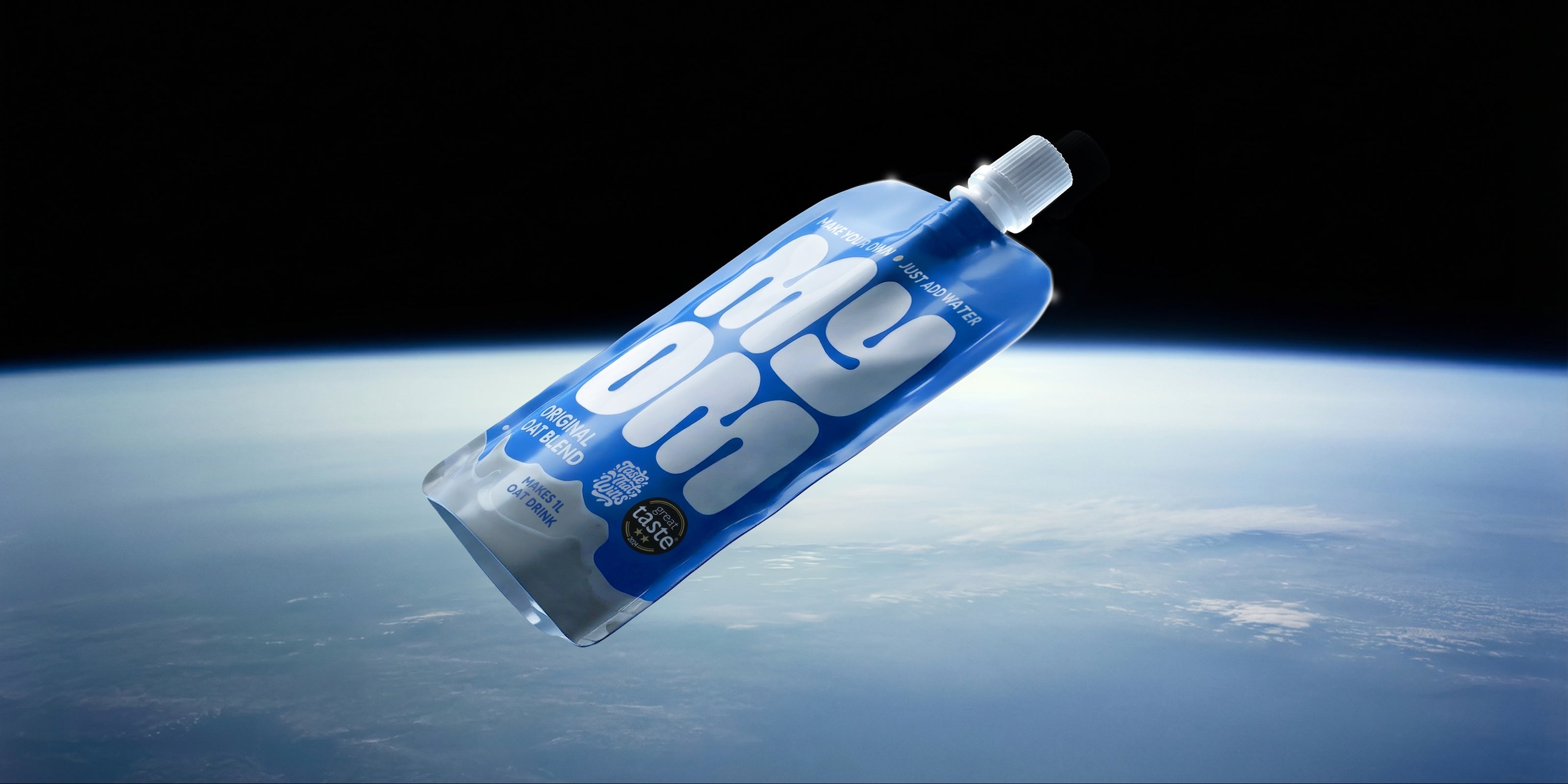


Somewhere between the factory and your fridge, most oat drinks travel hundreds of miles mostly as water: something it doesn’t need to be.
Europe’s 2026 food landscape has a message, and it isn’t subtle. Consumers aren’t waiting for bolder claims or trendier ingredients. They’re asking harder, simpler questions: Why does this cost so much? What’s actually in it? And if your brand talks about sustainability, can you show me where?
The EIT Food Consumer Observatory’s latest research, published in January 2026, confirms the shift. Across eighteen European countries, the same pattern repeats: affordability and trust now outrank aspiration. Practical sustainability beats virtue signalling. Familiar food, quietly improved, wins over radical novelty.
For oat drinks in the UK and across Europe, a category that grew on ethical promise and lifestyle appeal, this changes the competitive equation. The brands that thrive from here won’t be the loudest. They’ll be the ones whose format already answers the questions consumers are now asking.
This is what we see when we read those signals from MYOM’s perspective and why we believe the future of plant-based milk alternatives have less to do with marketing and everything to do with design.
|
Four signals that redefine what “good” oat drinks look like
The EIT Food research is dense, but its direction is unmistakable. Four converging signals matter most for anyone buying, selling or rethinking plant-based milk in 2026.
1. Cheaper oat drinks don’t compromise: the right of entry.
Affordability has overtaken sustainability as the second-largest driver of dietary change across Europe, trailing only health. Private-label grocery sales are up roughly 30% year on year. Consumers are naming shrinkflation out loud and walking away from brands they feel are overcharging.
This isn’t anti-quality sentiment. It’s anti-waste sentiment. People still want good food — they just refuse to pay a premium for inefficiency they can see. And a litre of oat drink that is 85–90% water, manufactured centrally, chilled, shipped heavy and stacked on a refrigerated shelf is, structurally, an expensive way to deliver oats to a kitchen.
Premix oat drink changes that arithmetic. By concentrating the product before it leaves the production line, MYOM reduces weight, volume and cold-chain dependency. The result is a genuinely lower cost per litre — not because we’ve cut corners on oat milk ingredients, but because we’ve cut water from the supply chain. For anyone asking “is there a more affordable oat milk that doesn’t sacrifice quality?”, well that’s precisely the question MYOM Oat premix was designed to answer. If the numbers matter to you (and in 2026 they should), we’ve laid them out here: Is premix oat drink cheaper?
2. Sustainable oat drinks must be structural, not decorative
European consumers haven’t stopped caring about the environment. But belief in individual action is weakening, and patience for green claims that don’t translate into visible outcomes has thinned considerably. The EIT Food data shows that sustainability only converts at point of sale when it arrives bundled with a practical benefit: lower cost, less waste, greater convenience.
This is good news for any product whose environmental advantage is baked into its format rather than bolted on through marketing. Removing water before dispatch means fewer lorries, lighter loads, smaller packaging per litre and drastically reduced spoilage risk. None of that requires the consumer to change a single habit. It’s sustainable oat milk by design, the kind the 2026 consumer actually trusts, because the maths is visible on the shelf. We explored the wider picture of whether a oat liquid premix vs powders here: Is oat powder sustainable?

3. Oat drink ingredients and trust: clean labels win
The 2026 research is blunt about trust: packaging is the most trusted communication channel. QR codes are friction. Brand storytelling is background noise unless backed by proof. What consumers want is a short ingredients list, recognisable components and credible certifications they can verify immediately. In other words, clean-label oat drink isn’t a niche preference anymore, it’s becoming the baseline expectation.
Oat drinks are walking into this reality at exactly the wrong moment. Across Europe and the US, scrutiny of ultra-processed foods is accelerating. The 2025–30 US Dietary Guidelines explicitly flagged UPFs for the first time. The EU is tightening green-claim regulation. Even Oatly has launched on-pack messaging to address consumer anxiety about ultra-processed oat milk head-on.
For MYOM, this environment plays to strength. Our ingredient list is short and legible. Our process is simple to explain: blended oats, a small set of functional ingredients, then water added by you at home to make fresh oat milk on demand. That isn’t a workaround, it’s transparency built into the product experience.
4. Oat drink protein and function matter, quietly.
Protein demand across Europe is rising, but consumer attitudes are more cautious than the headlines suggest. People want incremental improvements in the foods they already eat, not radical alternatives wrapped in biotech language. The EIT research frames this as “familiar foods, better performance” and the food industry is listening. As one protein-sector founder put it recently, diversification is becoming less visible but more impactful as proteins move into everyday products rather than standing alone.
This is exactly how MYOM treats protein in our oat premix. Our Barista Oat blend incorporates fava bean protein not as a headline claim but as a functional layer: better texture, better nutrition, no manifesto required. MYOM is naturally lower in sugar, lower in fat and lower in calories than many carton oat milks. MYOM has no stabilisers or acidity regulators like Dipotassium Phosphate and with MYOM you can adjust the mix to taste, make smaller amounts and avoid half-used cartons going to waste.
So, if you’re also thinking about sugar, calories and how oat milk fits a GLP‑1-conscious routine, that’s worth a separate read: Is oat drink GLP‑1 friendly?
The real question isn’t which brand, it’s which format
Most conversations about oat milk in the UK still happen at brand level: Oatly versus Alpro versus supermarket own-label. But the 2026 trends suggest the more consequential question sits one level deeper. The dominant format, factory-made liquid in a shelf-stable or chilled carton, was inherited from dairy. It assumes that the only place to add water is the production line. Every carton carries that assumption as literal dead weight through the entire supply chain.
Premix oat drink doesn’t ask consumers to give anything up. It asks the supply chain to stop shipping what the tap already provides. That single design choice cascades into the four things 2026 consumers care about most: a cheaper cost per litre, less packaging and transport waste, a shorter and more transparent ingredient list, and a fresher product made at the point of use.
It isn’t a lifestyle upgrade. It’s a system upgrade. And the distinction matters, because the EIT data is clear: consumers have stopped rewarding novelty for its own sake. They reward products that solve real, felt inefficiencies: the kind of better, more affordable oat milk that works harder without requiring behaviour change.
Where this goes next: two futures, one format advantage
The EIT Food Consumer Observatory doesn’t just map today’s behaviour. Its foresight programme models plausible 2035 scenarios for European food. Two of the four most likely futures are directly relevant to anyone choosing between plant-based milk formats.
Convenient and Affordable: a Europe where reformulated staples dominate, purchasing is price-led, and proven nutrition and safety are non-negotiable. In this world, premix wins because it is structurally cheaper, shelf-stable and generates less waste. MYOM Oat Drink premix is a better-designed staple.
High-Tech Savour: a Europe where processing delivers verified health and environmental metrics inside familiar food formats. Here, premix wins as a platform, a base ingredient format that can layer in protein, fibre and micronutrients without becoming alien.
The common thread is resilience. MYOM doesn’t depend on one trend holding. Its advantage is format-led, not trend-led, which means it compounds across scenarios rather than betting on a single future.
Choosing the best oat milk in 2026: a simpler framework
If you’re re-evaluating oat drinks in the UK this year, whether for your household, your café or your menu, the old checklist (taste, froth, brand) still matters. But the 2026 landscape adds new filters that are harder for legacy formats to pass.
Look for ingredients you can count on one hand. Ask what the real cost per litre is once you factor in waste and spoilage. Check whether the sustainability claim is about the product’s design or just its packaging copy. And consider whether the format itself prevents waste, or simply recycles it after the fact. The best oat drinks in 2026 will be the one that answers those questions honestly.
We’ve written a full breakdown for anyone comparing options: How to choose the best oat drink in the UK (2026).
The future of oat drinks aren’t louder. They're lighter.
Europe’s 2026 food trends aren’t calling for reinvention. They’re calling for honesty, efficiency and respect for the consumer’s intelligence. The brands that answer that call won’t be the ones with the biggest ad spend. They’ll be the ones that removed the problem before the consumer had to think about it.
We built MYOM around a simple conviction: better oat drinks are ones that don’t ship water. Everything the 2026 data confirms on value, on trust, on sustainability, on processing scrutiny, all flows from that same starting point. Cheaper, cleaner, more sustainable, not because of brand marketing, but because of a better design.
Sometimes progress doesn’t look like innovation. It looks like common sense finally catching up.

Ready to try premix oat drink?
Subscriptions are the easiest way to make the switch routine and right now, there’s a reason to start.
10% off subscriptions + an extra 10% off your first order. Shop Now
EU Food Trends 2026: Oat Milk FAQs
Is oat drink premix cheaper?
In most cases yes, per litre, due to less packaging, lower weight, less trucking and waste.
Is oat drink premix ultra-processed?
No. It typically involves fewer processing steps than oat milk in cartons and oat milk powder.
Is oat drink premix GLP-1 friendly?
Yes. The format supports portion control and moderation.
Keep reading:
• How to choose the best oat drink UK 2026
• Is premix oat drink cheaper?
• Is oat drink GLP‑1 friendly?
Data Sources & Attributions
External citations:
EIT Food Consumer Observatory (Jan 2026), EIT Food Top Trends 2026, Lancet UPF research (referenced), 2025–30 US Dietary Guidelines (referenced). MYOM Carbon Impact Forecast (CIF), October 2024, via Impact-Forecast.com. Poore, J., & Nemecek, T. (2018). Reducing food's environmental impacts through producers and consumers. Science, 360(6392), 987-992. Hannah Ritchie (2022) - "Dairy vs. plant-based milk: what are the environmental impacts?" Our World in Data.